
Daily Reflections based on Daily Lectionary of the Episcopal Church written by the clergy of Saint Stephen’s.

Our Sanitized Lens - September 12
Daily Reflection for Monday, September 12, 2022.
Today’s Readings: AM Psalm 56, 57, [58]; PM Psalm 64, 65; Job 40:1-24; Acts 15:36-16:5; John 11:55-12:8
This past week, I launched my reading group again after a three-month summer hiatus. We read a variety of books, usually nonfiction, but not always, and ranging on any number of unusual topics. Not all are religious and yet we trust God to be a part of the conversation and help us to discern how we can see God more deeply in the beauty of the world.
I selected our September Book from a list published by Time Magazine, a collection of poetry by critically acclaimed author Ocean Vuong titled Time is a Mother. The paragraph describing the collection and the litany of acclaimed authors and sources recommending it led me to believe it would be the perfect choice to kick off our fall series. Maybe it is. Maybe it isn’t.
As I started to work through the first poems, I wrote my class to warn them of the haunting, vivid, and visceral language that I found so shocking. I told another that I wouldn’t have selected this collection if I had read it before, which is also true. It’s painful, dark, and yet also beautiful and touching. As I slowly read each poem, I am being forced to wrestle with powerful images that I’d rather not see.
And yet, as I read the Scriptures appointed for this morning, I am struck that the setting of the story is when the Jewish people are making their way to Jerusalem before the Passover to purify themselves, an annual tradition of sorts. Their reason is the focus on cleanliness and being both physically and spiritually clean, an attribute of how they understand holiness and purity. And I am left wondering if my own uncomfortableness with such shocking and vivid imagery that captures the pain and loss of someone’s very human experience is an attempt to see the world through a sanitized lens, my own focus on holiness and purity.
The world is painful and broken. Saint Stephen’s likely understands this as much as any community could. I think we are tempted to come to church sometimes to escape this reality, to find beauty and peace that stands in stark contrast to the pain and agony of the world. The reality of God’s love breaking into this world is not the absence of grief, pain, trauma, or agony, but taking the reality of the world and making it holy. We can’t purify ourselves, and we don’t need to, because Christ has redeemed the world.
The world is complex. This is the world that Christ breaks into to make holy and redeem, and not a sanitized version of what we want to see. Maybe this understanding of the power of Christ can let us sit with the pain and discomfort of the world in new ways.
Faithfully,
John+
Questions for Self-Reflection: What stories of the world are painful for you to sit with? How can God help you to see that reality with new eyes?
Daily Challenge: Read a piece of poetry. I suggest the Poetry Foundation as a good source.

God Saved the Queen - September 9
Daily Office Reflection for September 9, 2022
Today’s Readings: AM Psalm 40, 54; PM Psalm 51; Job 29:1,31:24-40; Acts 15:12-21; John 11:30-44
Today’s Reflection
In the roll of the book it is written concerning me:
‘I love to do your will, O my God;
your law is deep in my heart.’”
I proclaimed righteousness in the great congregation;
behold, I did not restrain my lips;
and that, O Lord, you know.
Your righteousness have I not hidden in my heart;
I have spoken of your faithfulness and your deliverance;
I have not concealed your love and faithfulness from the great congregation.You are the Lord;
do not withhold your compassion from me;
let your love and your faithfulness keep me safe for ever.Psalm 40: 9-12
Yesterday, news began to spread around the world that the earthly life of Queen Elizabeth II of Great Britain and Northern Ireland had come to a close. She was at Balmoral, her retreat in Scotland, surrounded by all four of her children, and it is said that she died peacefully. As I was driving from Saint Stephen’s across town to do a home communion visit, I heard the news as it was announced on BBC Radio 4. As I arrived at our parishioners’ home, I found that they, too, were watching the news coverage on their television. We remembered Elizabeth in our prayers as we shared communion together.
Why do we Americans care about the life and death of a British monarch? Didn’t we break away to form the United States because we don’t want to be ruled by one? That is true of our nation, and also true as the Church of England parishes in the English colonies decided to break away to become our own church, the Episcopal Church—complete with a dramatic saga of sending men to Scotland to be ordained by their Scottish Episcopal bishops instead of Church of England ones.
Though our forebears made a conscious decision to create a new nation and a new church separate from those established in England, our forebears in the Episcopal faith very much wanted to continue on in the Anglican tradition of the Book of Common Prayers and all that goes with that. While our American Book of Common Prayer excludes prayers for the monarch, we do recognize that we are a part of a worldwide Anglican Communion and we are in communion with the Archbishop of Canterbury, who is appointed by the Head of the Church of England—who for 70 years, until yesterday, was Queen Elizabeth II.
As I read Psalm 40 this morning, with Elizabeth on my mind, I reflected on her roles as daughter, mother, sister, wife, and monarch, and how her responsibilities to uphold the United Kingdom and the Church of England sometimes complicated and added pressure in how she lived into her more personal roles. But we know that Elizabeth relied on her deep faith in Christ as she navigated her very distinctive role in the life of her family, her nation, and the world: “In the roll of the book it is written concerning me: ‘I love to do your will, O my God; your law is deep in my heart.’” The people of her nation and the Commonwealth are a “great congregation” like the one of which the Psalmist sings, and Elizabeth II was committed to living out a life of faith in Christ before the eyes of this great congregation.
Archbishop of Canterbury Justin Welby, recalling his last visit with the Queen in June, said this:
“I came away thinking, ‘There is someone who has no fear of death, has hope in the future, knows the rock on which she stands.’” He said that their final conversation had included “a little bit of gossip” and “some very wise words.” “You felt that history was in front of you, but it was history with those piercingly blue eyes twinkling, that extraordinary smile, and the relishing of a quick, dry comment.”
I’ve heard it said that each time the people of Great Britain have sung “God Save the Queen,” it could be thought of as the people praying that God would keep their monarch under his care, protecting her and causing her to flourish. As we look back on Elizabeth’s 96 years of life and 70 years as Queen, we can see clearly how God answered those many prayers to save their queen. And now we pray for the repose her soul, that God’s light may perpetually shine on her, that her memory may be a blessing, and that those who mourn and are entering a great time of transition will be comforted and granted God’s peace.
Becky+
A Collect for Queen Elizabeth II from the Church of England
O God, the maker and redeemer of all mankind, grant us, with thy
servant Queen Elizabeth and all the faithful departed, the sure
benefits of thy Son’s saving passion and glorious resurrection; that in the
last day, when all things are gathered up in Christ, we may with them
enjoy the fullness of thy promises; through Jesus Christ thy Son our Lord,
who liveth and reigneth with thee, in the unity of the Holy Ghost, one
God, world without end. Amen.

Stay curious - September 7
Daily reflection for September 7, 2022
Today’s Readings: AM Psalm 119:49-72; PM Psalm 49, [53]; Job 29:1,30:1-2,16-31; Acts 14:19-28; John 11:1-16
Thomas, who was called the Twin,* said to his fellow-disciples, ‘Let us also go, that we may die with him.’
A lifelong friend’s mother died last week. And today I preach at the funeral, giving thanks to God for Diane’s life and for the hope given to us in Jesus’ defeat of death. The family has asked that a portion of John 14 be read. In these words of comfort and hope, we hear the honest inquiry of Thomas, “Lord, we do not know where you are going. How can we know the way?” As the curious apostle appeals for more details and assurance, Jesus takes the opportunity to teach and reveal something transformative about himself: “I am the way, and the truth, and the life.” Thomas helped extract a bit more of a roadmap of faithfulness with Jesus.
In today’s text from the Gospel of John, we hear of Lazarus’ experience of illness and death, followed by Jesus’ miraculous awakening of his friend from the grasp of death. Jesus explains to his friends that Lazarus really was dead and not just asleep. Furthermore, the Messiah hopes that arousing his friend stirred the disciples to believe in the powers of Jesus, and that he is the Son of God. If Jesus’ abilities are revealed in Lazarus, what is the next adventure? Thomas is fully on board to find out, saying to the group, “Let us also go, that we may die with him.”
Some may speak ill of Thomas the Apostle, the Twin, the Doubter. I, however, find his impulsive witness one of refreshing, childlike honesty. He opens the minds and hearts of those around him through curiosity. Jesus welcomes his questions.
Friends, we face hard things around us – death, pain, fears, illness, feelings of inadequacy, and the like…and yet, St. Thomas the Twin invites us to stay forthright and proximate, faithful and ever-seeking Jesus.
Katherine+
Questions for Reflection
Who are the people who welcome your questions the most? How does it feel to be around them? Whose questions do you always welcome?
Daily Challenge
Get out one unlined piece of paper. Set a timer and spend three minutes writing any and all questions you want to ask Jesus. No question is too big or too silly or too impertinent. Do not stop writing. Once the time ends, put down the pen and close your eyes. Sit in silence for one minute, giving yourself into God’s presence. Feel God’s love and welcome. If you feel moved to journal following this time of reflection, write down the word or phrases that stand out.

‘My times are in your hand’ - September 2
Daily Office Reflection for September 2, 2022
Today’s Readings
AM Psalm 31; PM Psalm 35; Job 19:1-7,14-27; Acts 13:13-25; John 9:18-41
Today’s Reflection
But as for me, I have trusted in you, O Lord.
I have said, “You are my God.
My times are in your hand;
rescue me from the hand of my enemies,
and from those who persecute me.
Make your face to shine upon your servant,
and in your loving-kindness save me.” —Psalm 31: 14-16
In the Psalm appointed for this morning, Psalm 31, we hear the Psalmist alternating between naming the ways in which God has provided protection and strength with naming the ways in which the psalmist is continuing to experience troubles of many kinds. This psalm gives us a realistic view of what the life of faith is like. We find ourselves being pulled back and forth between moments of great sureness that God is there for us, loves us, protects us, and cares for us: “Be my strong rock, a castle to keep me safe, for you are my crag and my stronghold; for the sake of your Name, lead me and guide me” (31:3). And then we also feel, maybe even on the same day, moments of feeling utterly overwhelmed by life’s demands, besieged by people who would seek to bring us down, and alone amidst these challenges and pressures: “Have mercy on me, O Lord, for I am in trouble; my eye is consumed with sorrow, and also my throat and my belly. For my life is wasted with grief, and my years with sighing; my strength fails me because of affliction, and my bones are consumed” (31:9-10).
This is what I find most comforting about the psalms, though, this realistic depiction of what the life of faith is like—and the fact that the psalmist has this honesty in his rapport with the God to whom these psalms are addressed. As described in Psalm 31, God is not put off by the psalmist’s lamenting and venting: “Yet I said in my alarm, ‘I have been cut off from the sight of your eyes.’ Nevertheless, you heard the sound of my entreaty when I cried out to you” (31:22). In a moment of stress, the psalmist accused God of not seeing him, of not wanting to see him. And then we hear a beautiful word that changes everything: Nevertheless. I didn’t think you were there for me, God. Nevertheless, you heard me. You were still there listening for me, even when I just accused you of abandoning me in my time of need.
I was reading an essay by Sarah Woodard on the Mockingbird blog, in which she questions that paradigm of Christian piety, the “quiet time” with God. Rather, Woodard, like the psalmist, is encouraging us to take a more honest, realistic approach in our time of prayer:
Lamott eloquently stated that “prayer is taking a chance that against all odds and past history, we are loved and chosen, and do not have to get it together before we show up.” We can even show up angry — Lamott assures us that “God can handle honesty, and prayer begins an honest conversation.” Even if your prayer is “I don’t like You at all right now,” God can handle it, and it may be the most honest prayer you’ve prayed in a while.
We can show up disheveled, disorderly, and maybe even disinterested, and God will meet us there. God can meet us at the traffic line as we pray for patience for the old woman driving slower than the speed limit in front of us, or in the stillness of early morning light. He is there when we are wiping runny noses, walking dogs, and trying to keep our sanity while cooped up in quarantine. He will accept our own words or someone else’s, our “quiet time” and our “loud time.”
As we continue through challenging times as a society, as a church, and as individuals, frustrated that life just isn’t getting back to normal on the timeline we had hoped that it would, frustrated that there are not enough hours in the day to keep working at the same level of perfection that we normally expect from ourselves (feel free to insert your own list of frustrations and disappointments here), it’s important to remember that God already knows all about it. God knows we are frustrated at times and pulled in too many directions and wondering when things will ever get better. Nevertheless, God still hears us, and wants to keep hearing from us. Even when we aren’t feeling extra hopeful and positive—and maybe especially then.
—Becky+
Questions for Reflection
How honest do you feel you can be in prayer with God?
Do you ever feel like you must be more positive in prayer than you actually feel?
What would it be like to tell God you feel like God is not hearing you?
Daily Challenge
Take time, whether in writing or out loud or in silence, to be honest with God about something you have been holding back about in your prayer life.

Flower of hope in the trauma – August 31
Daily reflection for August 31, 2022
Today’s Readings: AM Psalm 38, PM Psalm 119:25-48; Job 12:1,14:1-22; Acts 12:18-25; John 8:47-59
On Sunday morning during the 9 o’clock service, I looked up at the cross that is built into the back wall of our nave behind the altar. Upon the rough surface of the slate grey beams, just beneath the ninety-degree angles created by their intersection, I saw something that caught my eye. It was a tiny white and green flower, waving in the circulation of air. Somehow this remnant of a fabulous floral display of limelight hydrangeas adorned and danced upon the cross. And it was beautiful.
As the Rev. David Peters, our guest preacher this past weekend, talked of Jesus suspended on the cross between heaven and earth, a beacon of hope for us as we weather times of trauma and devastating loss. I thought of that tiny flower. That reminder that hope springs eternal. That even on the darkest days, God brings beauty and assurance. Jesus was and is and will be a reminder and guide for us through the rough and turbulent terrain around us, because he has been in trauma and pain.
Many years before Jesus came to live among humans, we find Job in a piece of the text appointed for today. Job shares a hard and desperate account of his physical, spiritual, and emotional wounds. He rails against God and the pain of his own human existence. Mortals, he says, are “few of days and full of trouble”. If life is so fleeting like a shadow that barely exists, can God just look away and allow humans to enjoy a day or two? Unlike trees who can sprout new growth after being leveled or damaged, Job asks what happens to humans? Water is in a cycle of moving and drying up, but what of mortals? What is the purpose of all of this, Job inquires. He sees the movements of mountains crumbling and waters flowing to their next resting places. Job says, “so you destroy the hope of mortals. You prevail for ever against them, and they pass away; you change their countenance, and send them away.” (14:19b-20)
Job is living in a hard space with much trauma. He feels utterly alone and without hope. His lament is one that perhaps many of you have pondered…to feel so separated from the light of healing and grace from God. Like trauma, Job’s journey does not resolve quickly. And so, we cling to the hope of Jesus, to God’s faithfulness to us in the darkest of days, and gather together at the Table of our Lord to be nourished. You may be in turmoil today. I pray that you can open your eyes to the tiny flowers of encouragement and hope that quietly reveal themselves to you through the breath of the Holy Spirit. And remember two things; God loves you and you are never alone.
Katherine+
Questions for Self-Reflection:
Where have you found to be a surprising place of encouragement and hope? Have you shared details of this place with others? How often do you return there, physically or in your memory?
Daily Challenge:
Set aside about 20 minutes of quiet. Before beginning, get in a place of comfort, or bring an item that brings hope to you. Sit with God, just as you are. Reflect, pray, breathe. And when 20 minutes are finished, give thanks - even if that thank you is that your body was nourished with oxygen in those moments.

The Flag and God - August 29
The Daily Reflection for Monday, August 29, 2022.
Today’s Readings: AM Psalm 25; PM Psalm 9, 15; Job 12:1-6,13-25; Acts 11:19-30; John 8:21-32
Can you imagine being physically scattered because of your faith? I am guessing so much more is wrapped up in this story when we realize, a more historical account in the Book of Acts that is a precursor for much of history, where religious groups have had to find new places to live, but it stands out today. “Now those who were scattered because of the persecution that took place over Stephen.” Maybe I am paying intention because of the connection to our own Saint that this church is named, and my ears are conditioned these days a little differently.
Most of what I have experienced in my life is people who actively seek out a faith community or actively leave a community. Often it can be because of how one’s own faith lines up with the values of a community or a change in an understanding of God and who is included or excluded from community. But the decision to stay or leave is decided by the individual and it is a choice of free will.
A few weeks ago we moved both the Episcopal flag and American flag from the sanctuary to the Narthex during a wedding. Historically, flags have been put up during weddings, but instead of putting them up, they were moved to the Narthex. It might have been accidental, but I have left them there. Now, when one enters the church, the American flag is what is seen. I’ve been thinking about how appropriate this is. Our American flag is a secular symbol, and for most of us, it is the most important secular symbol we encounter. Secular symbols don’t make sense in a sanctuary. America is not the kingdom of God.
But it is our American freedom that allows us to enter the nave and worship however we would like. That is a remarkably precious gift that is not afforded to everyone. We don’t fear what those early Christians feared who were physically separated because of their faith, something that still happens in different parts of the world.
For the time being, I’d like to keep the flags where they are. And I’m hoping that for those of you who worship physically in the building, when you walk into the nave, you will be reminded of your freedom to do so, and how the story we read today is not our reality. Thanks be to God.
John+
Questions for Self-Reflection: What is the relationship of the flag to your Christian faith?
Daily Challenge: Find a place in the world (today) where people have had to move due to religious persecution. Spend some time reading about this place and praying for people there.

'It's about God' - August 26
Daily Reflection for August 26, 2022
Today’s Readings: AM Psalm 16, 17; PM Psalm 22; Job 9:1-15,32-35; Acts 10:34-48; John 7:37-52
Today’s Reflection
“‘He commanded us to preach to the people and to testify that he is the one ordained by God as judge of the living and the dead. All the prophets testify about him that everyone who believes in him receives forgiveness of sins through his name.’ While Peter was still speaking, the Holy Spirit fell upon all who heard the word.” Acts 10: 42-44
“On the last day of the festival, the great day, while Jesus was standing there, he cried out, ‘Let anyone who is thirsty come to me, and let the one who believes in me drink. As the scripture has said, “Out of the believer’s heart shall flow rivers of living water.”’ Now he said this about the Spirit, which believers in him were to receive; for as yet there was no Spirit, because Jesus was not yet glorified. When they heard these words, some in the crowd said, ‘This is really the prophet.’” John 7: 37-40
On our end-of-summer road trip, our last stop was Raleigh-Durham, North Carolina. We went to North Carolina to see a good friend of mine from college, who works as a software engineer in the Research Triangle. While we were there, we also spent some time at Duke University because I cannot stay away from a beautiful college campus. I brought a couple books back amongst my souvenirs—the two I picked from the campus bookstore are both by Will Willimon, who for 20 years was Dean of Duke Chapel before coming here to Alabama, where he served as a bishop in the United Methodist Church.
Willimon is a gifted preacher who for many years has taught courses and written books on preaching. I’ve been trying to read a bit each day from one of the books, Preaching Master Class: Lessons from Will Willimon’s Five-Minute Preaching Workshop. Each chapter is just two or three pages, truly a five-minute dive into some of his experiences and observations over the years as a preacher and as a teacher of preachers.
Yesterday I read a chapter titled “It’s about God.” On one level, this should be obvious: When we write or plan a sermon, we should be orienting ourselves toward God, we should be opening ourselves to proclaiming what God would have us to proclaim. When we preach, we should be pointing our hearers toward God. And yet, in contemporary preaching, there are pressures both from outside and inside to keep things safe. As Willimon argues,
As I consider many of the sermons that I hear and many of the sermons that I preach, I hear a decidedly a-theistic tendency. Many sermons are essentially ‘self-help.’ … I hear sermons that are little different from the advice one could receive from any self-help book. I fear that these preachers have allowed the seekers and their limitations to determine the content of the message. We Americans are a ‘do-it yourself’ society, a people who generally believe that, if our lives are going to be better, then it is mainly left up to us to improve them. We no longer want salvation, or conversion: we want self-improvement. Jesus becomes another helpful technique, among many other techniques, for getting what I want (97).
Too much talk about God (or Jesus or the Holy Spirit, or salvation or sin, or so many other things), and we might make some people feel uncomfortable. But we want people to stick around. We want people to keep coming back. And so, sometimes, we preachers may be tempted to play it safe. To say only what is reassuring. Comfortable words. Words that won’t offend. Words less likely to challenge.
But look at today’s Gospel passage from John and the New Testament passage from Acts. Jesus’ preaching did not make people comfortable. Peter’s preaching did not make people comfortable. Jesus and Peter challenged people in their preaching. They challenged people because always, always, always they were faithful in orienting their audiences to be turning toward God—and finding their true salvation and their true identities not in the love of self but in the unending, unquenchable love of God.
In the words of Will Willimon, “Christians don’t believe in self-help. We believe that we cannot help ourselves, exclusively by ourselves. We need a God who saves, who reaches in, and intrudes and acts to do for us that which we cannot do for ourselves” (98). Thanks be to God.
Becky+
Questions for Reflection
When have you heard a sermon that challenged you? What did you feel challenged to do or to reconsider after hearing that sermon?
Is it possible to be at once challenged and comforted when the Gospel is preached?
Daily Challenge
When you have heard a sermon that you wanted to listen to again or share with others, what was it about that sermon that resonated so strongly with you?
How might you conceive of your own actions and words as a sermon that you are preaching through your daily life?

Love, delight, and the law - August 24
Daily reflection for August 24, 2022.
Today’s Readings: AM Psalm 119:1-24; PM Psalm 12, 13, 14; Job 6:1,7:1-21; Acts 10:1-16; John 7:1-13
On this Wednesday school-day morning, the portion of Psalm 119 slated for today is perfectly suited. Now, I offer the reminder that I am a morning person; it does not take two cups of coffee and thirty minutes of silence to get me ready to take on the pressures of the day. I get out of bed and am (usually) ready to engage.
Psalm 119 begins in a way that I woke up this morning – happy and ready to follow the rules of God. The psalmist sings that those who observe the decrees of God are fulfilled, for they are seeking satisfaction to their core from the Lord alone. There is obedience and gratitude within my steadfast spirit. Getting ready for the day, there is a longing to follow the divine expectations laid out before all God’s people, “With my whole heart I seek you; let me not stray from your commandments.” (v. 10) The words of promise and devotion are beautiful, faithful, and focused:
I treasure your promise in my heart,
that I may not sin against you.
Blessed are you, O Lord;
instruct me in your statutes.
With my lips will I recite
all the judgments of your mouth.
I have taken greater delight in the way of your decrees
than in all manner of riches.
I will meditate on your commandments
and give attention to your ways.
My delight is in your statutes;
I will not forget your word. (v. 11-16)
The further I get from the prayerful start to the day, the more chaotic and isolated I can feel. Likewise, by verse 17, there is a shift. No longer with words of hopeful promise ahead, the psalmist looks only in the present and pleads to God to “deal bountifully” and “open my eyes”. The reality and hard parts of the day are here.
I am a stranger here on earth;
do not hide your commandments from me.
My soul is consumed at all times
with longing for your judgments.
You have rebuked the insolent;
cursed are they who stray from your commandments!
Turn from me shame and rebuke,
for I have kept your decrees. (v. 19-22)
The psalmist is really struggling. I notice the quick shift from delight in the law of Yahweh, to fear that the commandments – one of the few lasting, permanent signs of communication between God and the people of early Israel – might be taken away and obscured from sight. Sometimes the trajectory of my day pivots, swinging in a way that is askew to the way I woke up.
In this psalm, I see a surprising intermingling between law and emotion. In the dualistic paradigm of American culture, I do not expect these two to be interwoven, and yet, the ancient lyricist created this work of expressing how the structure of God – the hopefulness of our Lord – can be internalized and digested to nourish the faithful who seek to follow God.
Upon prayerful reflection, we also can proclaim heartily that the Lord’s decrees are our delight. These words, which give shape to what it means to be living faithfully with God and for God, truly become our counselors at all times, day or night.
Katherine+
Questions for Self-Reflection:
When you think of laws and commandments, what images come to mind? And how to God’s laws differ from the laws of our land?
Do you lead first with rules, or desires, or something wholly different?
Daily Challenge:
Reread the rules we know as the Ten Commandments. Meditate on them (as we hear in Psalm 119:23). What words or phrases stand out? Spend five minutes (or more) journaling about how they resonate with you today.

Become what you Receive - August 22
Daily reflection written for August 22, 2022.
Today’s Readings: AM Psalm 1, 2, 3; PM Psalm 4, 7; Job 4:1,5:1-11,17-21,26-27; Acts 9:19b-31; John 6:52-59
In a few weeks, I will once again make my way to Cambridge, Massachusetts to spend four days in retreat at the monastery run by the brothers of the Society of Saint John the Evangelist (SSJE). These men have given their whole lives to living the Gospel of Jesus Christ and they make their grounds available throughout the year for people to come and worship with them in the ancient monastic traditions. I am eager to sit in the holy quiet of the sacred space and pray for Saint Stephen’s and rest in God’s loving embrace.
I was there in 2019 for retreat and had planned a retreat in 2020 that was canceled due to the pandemic. When I was visiting in 2019, I heard these words for the first time, “Behold what we are: May we become what we receive.” These words were the words of invitation to communion. The priest offered, “Behold what we are” and the congregation responded, “May we become what receive.”
What a beautiful image for the sacred meal of communion. We reflect on our human nature and our capacity as humans and yet we pray to become the sacred gift that we so deeply desire and with the assumption that the meal actually transforms our very lives. Today’s Gospel lesson from John is a dialogue of Jesus telling others that for those “who eat his flesh and drink his blood, abide in (him).” It’s likely that this part of John is an early liturgical text of the Christians of the Johannine community, a reminder of how this sacred meal that we partake in, week in and week out has been around for nearly two millennia.
Not only is the practice of communion ancient, but I find it deeply necessary. When I need nourishment, I find it at the table. When I need hope, I find it at the communion rail, people hungry for love, acceptance, grace, and justice, all coming forward and extending their hands and asking, even when they don’t even know it, to become what they receive.
It’s why to renew my own soul, I’m not traveling to a beach or even a cold-water trout stream, but to an altar rail surrounded by men in cassocks who have committed their whole lives to living out the Gospel of Jesus Christ.
We get the same opportunity each Sunday, and this week especially I pray that your walk forward on Sunday, that each of our extension of hands will not only help us to ‘behold what we are,’ but ‘become what we receive.’ I look forward to seeing you at the Altar rail on Sunday.
John+
Questions for Self-Reflection: How does the practice of communion shape your life? Have you had transformative moments at the altar rail?
Daily Challenge: Spend some time navigating the website of SSJE, specifically the monastic wisdom for everyday living.

Turtle 9-1-1 -- August 17
Daily reflection for August 17, 2022.
Today’s Readings: AM Psalm 119:145-176; PM Psalm 128, 129, 130
Judges 18:16-31; Acts 8:14-25; John 6:1-15
Yesterday, there was a police officer stopped in my neighborhood, about six houses from our house. The officer’s vehicle was running and his blue lights were on. He was blocking one lane of a road that drivers habitually speed up and down. Standing on the passenger side of his car, he was examining something on the asphalt.
On foot and finishing a jog, I drew closer and realized it was a turtle. Its shell was patterned with the colors of coffee and wheat, probably five inches wide and seven inches long. The tall man crouched down, casting a shadow over the creature. He poured water in the cap of a water bottle, placing it in front of the turtle. He watched and waited.
I offered greeting, as I was walking by. The officer, patient and composed, said he was trying figure out which way the little turtle wanted to go, so that he could set it on its way safely. As we spoke, a car was driving up the road. It stopped behind the police car, before carefully going around. The turtle moved – surprising quickly – toward the shade under the officer. That reptile found safety with the kind and attentive Hoover police officer.
I did not linger to see where the turtle ended up or the officer’s role in that movement. I went home and got ready for work. This morning, the continued story of apostles John and Peter in Acts 8 reminds me of the “turtle 9-1-1” scene. Much like Officer Wiggins, the apostles knew their job – to bring peace, protection, and healing to those in need. They were attuned to the vulnerable ones around them. In Peter and John’s context, it was sharing the Good News with the people of Samaria. The apostles prayed for the Samaritans and laid hands on them, so that they could receive the Holy Spirit. John and Peter wielded this power from God in a discerning, responsible manner. When Simon Magus wanted to capitalize on this apostolic gift to use it for parlor tricks and swindling people out of money, Peter was quick to shut him down. The work of those following Jesus’ directions was to glorify God through sharing the hope and renewal offered in believing the word of God.
Let us pray for one another. Let us ask God to help us open our eyes to the need around us. And, let us use our God-given gifts to spread kindness, hope, and inspiration to those around us.
Katherine+
Questions for Self-Reflection:
What does seeing a helper in action remind you of?
Who is easy to help? Who is hard to help?
Daily Challenge:
Pray today for God to open your heart and fill you with the courage you need to offer help and encouragement to someone around you. Then, pause and reflect: where do you need help today?

Grace Happens - August 15
Daily Reflection for August 15, 2022
Today’s Readings: AM Psalm 106:1-18; PM Psalm 106:19-48; Judges 17:1-13; Acts 7:44-8:1a; John 5:19-29
There are still Episcopal church plants today. A friend has started a new Episcopal Church in Oklahoma a few years ago called Grace Episcopal Church. They have just built their own building and next Sunday will be their first Sunday in their new sanctuary. Grace is a common name for churches as who can deny, we all need a little more grace these days.
I had a moment last week where it felt like the weight of it all was too much. In addition to my role as a priest and Rector of an Episcopal Church, I am navigating helping my in-laws transition to a new life of assisted living facilities and a move to Alabama, parenting two over-committed children, and trying to be a supporting spouse to a partner who is starting her own business. I was at home for a few minutes and our aging cat just looked at me, I think she might have winked, and then walked over to the corner and peed in a basket on the rug in our bedroom. (We have taken her to the vet, are having blood work done, and I am very aware this is often the sign of something wrong with a cat’s health). Oh, did I mention that my computer died last week in the midst of trying to run a finance committee meeting on zoom?
I had this moment where I almost screamed, “I can’t hold it all together!” and then it dawned on me, that I don’t have to. This is the beauty of our faith! Grace happens. The weight of the world is too much. An endless endemic or pandemic, new diseases, rising inflation that affects our daily living, and so many other concerns. We can’t hold it all together, and yet the truth of our faith is that Grace happens anyway. God’s love is always there, will always break through, and will always be the source of strength to start again. Grace – that’s a lovely name for a church.
Today’s epistle is about the martyrdom of Stephen, the first martyr of the Christian faith. It’s where our Saint Stephen’s gets its name. It’s a story I have reflected on quite a bit in the last two months and has been lived out in our common life together. There are also churches named for the Advent (the coming of God’s reign), the Epiphany (the realization of Good News), and Resurrection (God’s victory over death), and while these names are of churches, they are all parts of our own faith story.
But today, I needed to hear grace and to remind myself that I can’t hold it all together, and I don’t need to. Maybe you need to hear that message too. God will always be there to pick us up and give us the strength to start the day again. Even when the cat has just destroyed another part of your home.
John+
Questions for Self-Reflection: What Christian truth do you need to hear most right now? How does your faith help you to navigate the stresses of life?
Daily Challenge: Read the story of Stephen in Acts again.

'I forget to eat my bread' - August 12
Daily Reflection for August 12, 2022
Today’s Readings:
AM Psalm 102; PM Psalm 107:1-32; Judges 14:20-15:20; Acts 7:17-29; John 4:43-54
Today’s Reflection
Lord, hear my prayer, and let my cry come before you;
hide not your face from me in the day of my trouble.
Incline your ear to me;
when I call, make haste to answer me,
For my days drift away like smoke,
and my bones are hot as burning coals.
My heart is smitten like grass and withered,
so that I forget to eat my bread.
Because of the voice of my groaning
I am but skin and bones.
I have become like a vulture in the wilderness,
like an owl among the ruins.
I lie awake and groan;
I am like a sparrow, lonely on a house-top.
—Psalm 102: 1-7
Have you ever been so overcome with sadness or worry that it made it hard for you to do the basic things of life? Like get out of bed in the morning. Or brush your teeth. Or get dressed. Or even eat your breakfast, lunch, and dinner. Let alone be amongst people or carry out other responsibilities. Oftentimes with depression, anxiety, and stress, the basic rhythms of life—doing the very things needed to sustain our lives—may get disrupted. Some people may not be able to eat, while others may eat more than they need—either way, it’s a disruption of the optimal circumstances for maintaining our physical, emotional, and spiritual health.
Like my grandmother before me, when I go through times of great stress, often my body’s natural response is to have no appetite. Last year, for instance, when going through a stressful time, I lost over 20 pounds for no good reason—well there was an underlying reason, but it certainly wasn’t my wish to lose my appetite. It wasn’t a purposeful or conscious thing, it was just how my mind and body often respond to stress. But conversely, when I regained my appetite and gained all the weight back, I took it as a sign that I was in a better place not only physically, but also emotionally and spiritually. My physical health, as evidenced by my appetite and ability to sleep well, mirrored my improved emotional wellbeing.
In Psalm 102 appointed for today, we read of the psalmist who is going through a similar set of circumstances, so overwhelmed “in the day of trouble” that it feels like “my days drift away like smoke” and “my heart is smitten and withered” to the point that “I forget to eat my bread… groaning” with hunger, becoming “but skin and bones.” Not only that, but the psalmist’s sleep is disrupted, “I lie awake and groan.” Emotionally, the psalmist is feeling isolated, “like an owl among the ruins” or “like a sparrow, lonely on a house-top.” It feels to the psalmist, amidst whatever very hard circumstances she is going through, that “my days pass away like a shadow and I wither like the grass.”
When we go through the hardest of times, it is challenging to see light in our darkness. It may seem that things will never get better. But as “smitten” and “withered” as the psalmist was, eventually she is reminded that she is not alone. God is there with her in whatever sorrow or stress or mess that she is going through: “But you, O Lord, endure for ever, and your Name from age to age. You will arise and have compassion on Zion, for it is time to have mercy upon her; indeed, the appointed time has come” (102: 12-13).
With God, we have the comfort of knowing that we are never alone, and that we are transformed through the never-ending love and compassion of our God:
In the beginning, O Lord, you laid the foundations of the earth,
and the heavens are the work of your hands;
They shall perish, but you will endure;
they all shall wear out like a garment;
as clothing you will change them,
and they shall be changed;
But you are always the same,
and your years will never end.
Becky+
Questions for Reflection
When in your life have the normal rhythms of eating, sleeping, and other daily activities been disrupted by overwhelming sorrow or stress? What happened to restore your physical, emotional, and spiritual wellbeing?
Daily Challenge
Are you going through this kind of sorrow or stress as you read this reflection today? If you are, please let a friend or family member or one of your clergy know as a first step toward regaining your health and wellbeing.
Or if you see someone who may be, take the time to check on how they are doing. Offer to just spend time with them as a way of offering your support and love.

Bilbo’s Song – August 10
Daily reflection for August 10, 2022.
Today’s Readings: AM Psalm 101, 109:1-4(5-19)20-30; PM Psalm 119:121-144
Judges 13:15-24; Acts 6:1-15; John 4:1-26
Probably fifteen years ago, I bought J.R.R. Tolkien’s The Lord of the Rings. While I had friends who read it growing up, I had not. I loved watching director Peter Jackson craft the beloved words from Tolkien’s pages into breath-taking cinematic blockbusters in the 2000s. And still, that big book sat on my shelf. Until last year.
I started trudging through, with Frodo and his buddies, on the epic and perilous journey in which the Ring-bearer ventured on the Quest of Mount Doom – down a dark, narrowing path. I’ll be honest: for me, The Lord of the Rings is a fascinating read – and not a fast one. The words slowly build. The images grow warm in my mind. The care for detail radiates beauty and chaos, much like the world of the Hobbits, elves, dwarfs, and others. And then, Tolkien inserts poetry and song into the midst, changing the pace of interactions among characters – and with the reader.
Protagonist Frodo Baggins and eight others are chosen to form the Company of the Ring to bring goodness and hope as they resist and evade the Nine Riders that are evil. Bilbo Baggins, Frodo’s elderly uncle, must stay behind in Rivendell. His days with the powerful Ring are behind him. Bilbo and Frodo spend time in conversation before the Company departs. The elder Baggins breaks off into song:
I sit beside the fire and think
Of all that I have seen,
Of meadow-flowers and butterflies
In summers that have been;
Of yellow leaves and gossamer
In autumns that there were,
With morning mist and silver sun
And wind upon my hair
I sit beside the fire and think
Of how the world will be
When winter comes without a spring
That I shall ever see.
For still there are so many things
That I have never seen:
In every wood in every spring
There is a different green.
I sit beside the fire and think
Of people long ago,
And people who will see a world
That I shall never know.
But all the while I sit and think
Of times there were before,
I listen for returning feet
And voices at the door.
Bilbo’s quiet song, sung to himself as he looks out the window, is poignant in its reflections upon what is past, the warmth of what is here now, and what is ahead.
As I read Psalm 101 appointed for this morning, I am grateful for the prayerful depth that can come from sharing the stirrings of our hearts through written and sung words, from a people rooted in living with and relying upon God. These verses show faith in the Lord and struggles through life. The psalmist writes: “I will sing of mercy and justice; to O Lord, will I sing praises.” The singer will try to do what is right, though it is God’s guidance that is really needed. There are promises to live in the right ways. There will also be times of destruction and brokenness – and the faithful psalmist proclaims, “I will soon destroy all the wicked in the land, that I may root out all evildoers from the city of the Lord.”
The psalms show us how prayer and song woven together can open us to God’s wisdom. And when shared, others can offer their voices to these prayers of promise and hope – on the dark days and on the brighter ones.
Katherine+
Questions for Self-Reflection:
What is a poem or song that you love to recite, sing, or hear?
Where are you in your life’s journey today? In a space of goodbye or departure? Comfort where you are in the middle? Struggle and cloudy skies amid hard realities? New beginnings with welcome and hope?
Daily Challenge:
Spend time with a psalm or poem or song that brings you peace and joy today. Read the words. Listen to the rhythm. Breathe in and feel the holy inspiration of God. Reflect on what about that piece strikes you. Then, talk to a friend about that work of art. Share why it moves you. As your friend about a work that is meaningful to them.

Encounters in the Darkness - August 8
Daily Reflection written for August 8, 2022.
Today’s Readings: AM Psalm 89:1-18; PM Psalm 89:19-52; Judges 12:1-7; Acts 5:12-26; John 3:1-21
Nicodemus has a few encounters with Jesus throughout John’s Gospel. Today’s lesson is his first encounter when he visits Jesus in the middle of the night asking questions about the teaching that Jesus has been sharing. Later in John’s Gospel, it is Nicodemus who asks Jesus about the laws around judging and who receives a hearing. It is the last encounter that is most interesting when he appears at the crucifixion to provide spices and help Joseph of Arimathea embalm Jesus’s body. Nicodemus, who first comes to Jesus at night, is there in the day to care for him in the most tender and intimate of all encounters. He must have really loved him, known him, and been moved by his life to show up and help Joseph. There is so much that we don’t really know.
I am especially struck by the intentionality that the author places on when Nicodemus arrives. He arrives at night. Is he scared? Does he have to travel when others are asleep? Or is it more about visibility and not being able to see? Nicodemus arrives in the dark. It’s certainly an important detail, as most every detail in the Gospel of John is intentional and points to some truth we are to discover.
Is the same truth our truth as well? Does our own arrival to Christ in the darkness with questions and concerns deepen our faith in a way that enables the ultimate compassion shown by Nicodemus at the crucifixion? Does facing our own pain and brokenness become a catalyst for Christ’s compassion?
If we are to play with this metaphor a little longer, I would say in my own life and what I have witnessed in pastoral relationships is a few different approaches to pain or darkness. Often it seems as if we ignore pain, it will just go away. Or if we cover it up we can just keep moving on and no one will notice. How different our lives could be if we faced what we don’t like or want to ignore turning it over to God for the strength to explore what we would rather not face.
The Nicodemus metaphor might suggest that this is the source of our compassion. Our ability to be with others in their pain and suffering, to reach out in love and compassion is a direct result of our own self-discovery and the willingness to invite God into our moments of doubt, pain, and darkness. I am pretty sure human beings aren’t meant to be perfect. I am also pretty sure we are meant to be compassionate. Maybe the source of compassion in our own exploration into who we are, pain, darkness, and all.
John+
Questions for Self-Reflection: How often do you reflect on your own spiritual life? What are moments of darkness for you?
Daily Challenge: Consider making an appointment with a clergy member for the rite of Confession and reconciliation. This is not often done in our tradition but is exceptionally powerful and a wonderful spiritual tool.

Living Letters of Recommendation - August 5
Daily Reflection for August 5, 2022
Today’s Readings: Psalm 84; 1 Kings 19:1-12; 2 Corinthians 3:1-9,18; John 12:27-36a
Today’s Reflection
Are we beginning to commend ourselves again? Surely we do not need, as some do, letters of recommendation to you or from you, do we? You yourselves are our letter, written on our hearts, to be known and read by all; and you show that you are a letter of Christ, prepared by us, written not with ink but with the Spirit of the living God, not on tablets of stone but on tablets of human hearts. 2 Corinthians 3: 1-3
In my first vocation as university professor, I was often asked to write letters of recommendation for students applying both for further study and for their first professional jobs. I also used to receive lists of references when I was involved in running national searches for new tenure-track professors in our department. In our cultural context, as in many others, it is important to have people who are willing to stand up with you, allow their name and reputation to be attached to yours, and who want to help you as you work to realize your hopes and dreams. Letters of recommendation and reference lists are all about credibility, specifically about reflected credibility: the way in which someone else’s good reputation has the power to enhance someone else’s credibility by association.
In today’s reading from 2 Corinthians 3 (one of the readings appointed for the Eve of the Transfiguration), the Apostle Paul writes to his friends in Corinth about not needing letters of recommendation, whether to you or from you. This is puzzling, in a way, as Paul’s work as an evangelist depends much on being part of a social network. Paul needs people to speak well of him and his colleagues. Paul needs the reflected credibility of people who have already seen their lives changed by the Gospel he has shared with them, especially by well-connected people in the many different Mediterranean cities in which he was planting churches.
So, why, then does Paul see such recommendations as unnecessary? Because Paul knows that there is something better than a stellar letter of recommendation: the very lives of the people who have been transformed “with the Spirit of the living God.”
In the world of Episcopal churches and clergy, part of the process of discerning a call to ministry and communicating who you are and what gifts you bring is composing and updating something called your OTM (Office of Transition Ministry) Portfolio. This portfolio (a detailed online application that can be accessed through a national database) includes not only the details of your education and past jobs, but also eleven narratives on various aspects on ministry and a section in which you are to list people who can speak to their experiences of you in ministry and other contexts. So, it is funny, in a way, that while the Apostle Paul doesn’t see much need for letters of recommendation per se, the Office of Transition Ministry, bishops, canons to the ordinary, rectors, and search committees really want to see a compelling list of credible references whom they can call to learn more about who we are and whether we might be a good fit for a particular ‘call’ or professional position within the Episcopal Church. (Saint Stephens required this when we were discerning whether I would be called to be an associate rector here two years ago.)
But at the very top of the Ministry Portfolio, just under your name and even before your order of ministry and the name of the Diocese with which you are affiliated, is a very open-ended item called the “personal ministry statement.” In this box, you have the opportunity in 250 characters or less (including punctuation and spaces), “to express your call to ministry in God’s mission in the world.” That’s a lot of ground to cover in 250 pages or 250 words, let alone 250 characters!
As someone who tends to go longer rather than shorter in my writing (as you readers of these reflections know), to craft such an important yet concise statement seemed like a real challenge. But then it occurred to me, I don’t have to use my own words—I could just decide on a piece of scripture that captures my sense of call. And these are the words I chose: “You yourselves are our letter… to be known and read by all; and you show that you are a letter of Christ, prepared by us, written not with ink but with the Spirit of the living God, not on tablets of stone but on tablets of human hearts” (2 Corinthians 2: 2-3).
Becky+
Questions for Reflection
In what ways is your very life a letter of recommendation for the difference the saving love of Christ can make in a person’s life?
Daily Challenge
Read what organizational psychologist Adam Grant suggests would be better than asking prospective high school students to submit personal essays, standardized test scores, and letters of recommendation in this column he penned for The New York Times, “Throw Out the College Application System.” Or take a peek at his list of bullet points on “How Not to Ask for a Recommendation Letter: 13 Mistakes to Avoid” in Psychology Today.

Bring your brother to Jesus - August 3
Daily reflection for August 3, 2022.
Today’s Readings: AM Psalm 119:97-120; PM Psalm 81, 82; Judges 7:19-8:12; Acts 3:12-26; John 1:29-42
Reading the pieces of Holy Scripture appointed each day in the Daily Office lectionary opens my eyes in many ways. One is moving through books of the Bible, taking in the stories and reflecting on the actions of God’s people across time…and the feeling of accomplishment when one book is finished and another is begun.
The last time I read today’s excerpt from John 1:29-42, I remember being moved by Jesus’ invitation for the newly recruited disciples to come and see. Two of John the Baptist’s disciples are dumbstruck when they saw the Lamb of God…so much so that they just start following Jesus. The Son of God turns around and says, “What are you looking for?” Andrew is one of those walking after Jesus…he and his unnamed companion do not answer Jesus’ question. Instead, they ask Jesus, “Rabbi, where are you staying?” The teacher responds, “Come and see.” They spend hours with Jesus. Perhaps they share a meal, tell stories, sit in peace.
Then, Andrew does this beautiful thing. Being so moved by his experience, he goes to his brother Simon. “We have found the Messiah,” he blurts out to his brother. It is a message that feels as if it is delivered with excitement and longing, satisfaction and joy. Then, Andrew brings his brother to Jesus. When the Anointed One sees Simon, he says, “You are Simon son of John. You are to be called Cephas.”
So often in remembering the flow of the Bible, I think about Jesus naming Simon Peter. That is a beautiful space to imagine – what would Jesus say to you or to me, meeting face to face? And, what strikes freshly today is that Andrew brings his brother to Jesus. That glorious re-naming happens because one brother cares enough about another to share the Good News…to invite someone else in to that special space of healing and understanding and hope and refreshment.
Someone brought me to Jesus. Someone brought you to Jesus. Who else needs an invitation?
Katherine+
Questions for Self-Reflection:
Who brought you to know Jesus?
When you have invited someone to church? To know Jesus?
Daily Challenge:
Ponder how inviting someone to church and inviting them to know Jesus can look similar and how the two can be different. Then, pray about the power of invitation. As you feel moved, invite a brother, sister, or friend to meet Jesus.

Learn, Gather, Pray - August 1
Daily Reflection for Monday, August 1, 2022.
Today’s Readings: AM Psalm 80; PM Psalm 77, [79]; Judges 6:25-40; Acts 2:37-47; John 1:1-18
“They devoted themselves to the apostles’ teaching and fellowship, to the breaking of bread and the prayers.” Following a remarkable and first Pentecost, Peter began preaching. We are told that those who welcomed his message were baptized, and they lived out the Christian life in this way. It’s taken me nine years to baptize maybe 100 people or so and Peter had 3000 people baptized in one morning. I guess I have a few things to learn!
I’m struck by the simplicity found in Acts of the Christian life. A dedication to the apostles’ teaching and fellowship, a commitment to breaking bread, and prayers. Recently, I was having a conversation about strategic planning with our Senior Warden (Chair of the Board). We have a pretty informal plan that we like that includes committing to outreach (care for people in need), pastoral care (care for people in our community), formation (Christian learning), and caring for creation (taking care of our home) and these should be encouraged by our worship together. I like our vision, but Acts breaks it down even further.
In the offices of Saint Stephens, we are doing some cleaning. We have converted the old choir room in the office suite to be two offices and our staff conference room. The closets were in desperate need of being cleaned out. Just after starting this reflection on Thursday afternoon, to be finished Monday morning, I unrolled a banner that had this passage of Scripture. Was this used at Saint Stephen’s at one time as a vision for the Christian life? (This line is also one of the questions of our Baptismal Covenant).
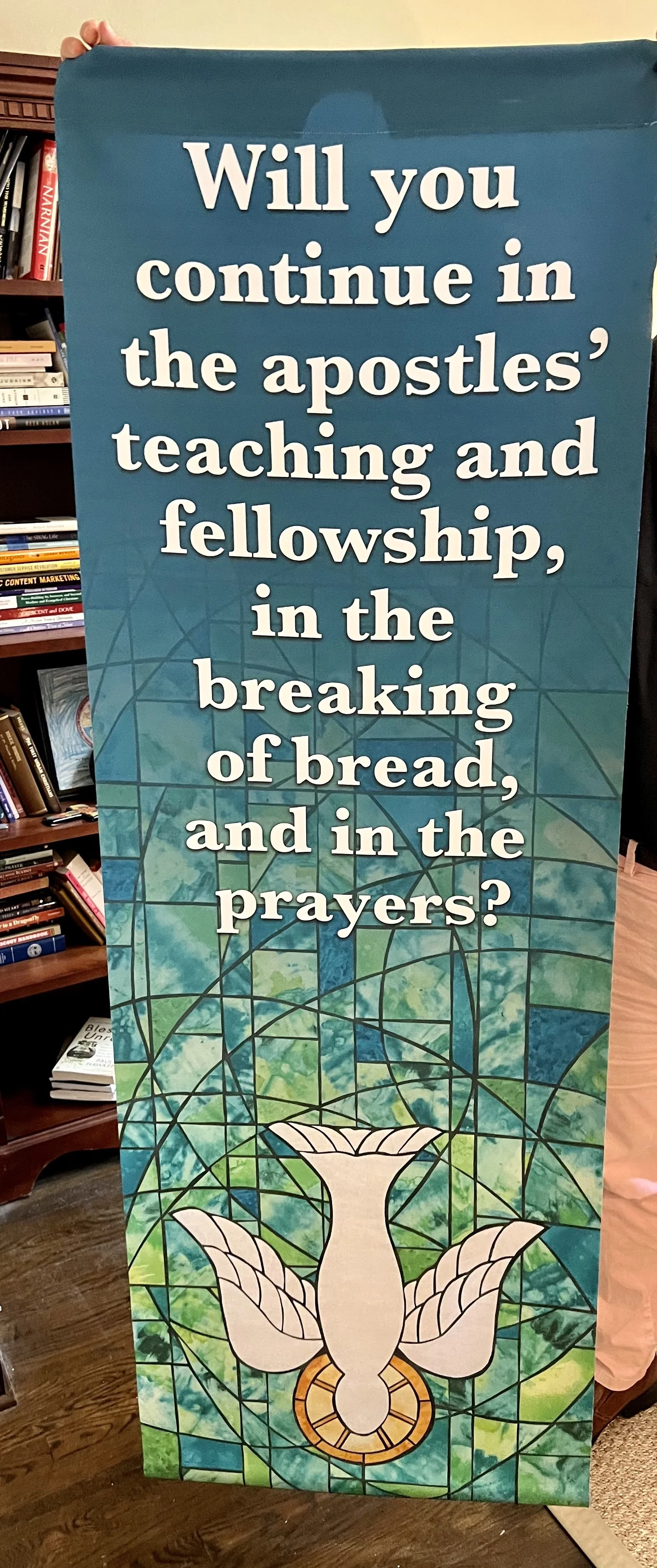
Maybe it is as simple as the book of Acts – learn, gather, pray. We shouldn’t diminish the power of our worship, of prayer, and the studying of Scripture. Saint Stephen’s might have a small church feel, one of the benefits of multiple worship services, but we are a corporate church with lots of programs. It can be challenging sometimes to navigate community, and to figure out just what is necessary for our own growth in our faith and love of God. Today is a reminder that sometimes the busyness of the programs doesn’t matter. Just showing up to pray and learn does. I hope I’ll see you Sunday (the schedule changes to 7:45 a.m., 9:00 a.m., 11:15 a.m., and 5:00 p.m.) and I’ll trust that’s enough.
John+
Questions for Self-Reflection: If you were to pick a mission statement for the church, what would it be? Does the Acts vision miss anything you think is necessary? Did you know the informal vision of Saint Stephen’s before? Does it make sense to you?
Daily Challenge: Learn, gather, pray. Right these three things down on an index card and next to each one, write, how you commit to doing it. Place the card in your purse or wallet as a reminder.

The Eleven - July 29
Daily Reflection for July 29, 2022
Today’s Readings: Psalm 33:1-5, 20-21; Esther 12:10-16; Romans 12:9-13; Luke 10:38-42
Today’s Reflection
O God, you poured your Spirit from on high to bless and summon these women, who heard the strength of your call: Equip, guide, and inspire us with wisdom, boldness, and faith to trust you in all circumstances, hear you preach new life to your church, and stretch out our hands to serve you, as you created us and redeemed us in the name of Jesus Christ, who lives with you and the Holy Spirit, one God everlasting. Amen. (Collect for the Commemoration of the First Ordination of Women to the Priesthood in Episcopal Church, July 29, 1974, from A Great Cloud of Witnesses)
Forty-eight years ago, on July 29, 1974, at the Church of the Advocate in Philadelphia, the very first women were ordained to the priesthood in the United States. Those eleven women, and it’s important that we take a moment to remember their names—Merrill Bittner, Alla Bozarth-Campbell, Alison Cheek, Emily Hewitt, Carter Heyward, Suzanne Hiatt, Marie Moorefield, Jeanette Piccard, Betty Schiess, Katrina Swanson, and Nancy Wittig—are now known in the history of the Episcopal Church as “The Philadelphia Eleven.” One of the Philadelphia Eleven, Alla Bozarth-Campbell, in her book Womanpriest: A Personal Odyssey, included a poem she composed that captures the context in which her ordination occurred:
Incomplete, they call us, unrecognizable.
Because we are eleven
and not the Magic Twelve
of your chosen few?
Because we are female…
And not important enough
to mention in Matthew,
Mark, Luke, or John,
our Hebrew sisters
present at your First Feast?
Even after the Eleven were ordained, they continued to face barriers to living into the ordained ministry to which they had been called. Because the General Convention of the Episcopal Church had not yet revised the wording of the church canons to include all, regardless of gender, many called their ordination invalid. It wasn’t just these eleven women who I consider to be in the “great cloud of witnesses” that opened the door to women, like me, to be ordained as priests. Four bishops, whose names also deserve to be remembered: Bishop Daniel Corrigan, former suffragan bishop of Colorado; Bishop Robert L. DeWitt, former bishop of Pennsylvania; and Bishop Edward R. Welles II, Manset, Me., retired bishop of West Missouri, and the Rt. Rev. Antonio Ramos, Bishop of Costa Rica.
These bishops were part of the church establishment but were willing to use their places of privilege to promote equal opportunity for women to serve not only as lay people and deacons, but also as priests in the Episcopal Church. Bishop Ramos, as documented in a July 31, 1974, press release found in the Archives of the Episcopal Church, said that this ordination: “stands as a prophetic witness on behalf of and for the oppressed.” He added that the ordination of the eleven women can “be characterized as an act of disobedience, ecclesiastical disobedience on our part, willfully done to abolish a system of canon law which is discriminatory, and which can no longer stand the judgment of the liberating Christ.”
The preacher at the ordination service was the vice president of the House of Deputies, Dr. Charles Willie, who “said that he participated in the service ‘not because I wanted to speak out but because I could not remain silent.’ Dr. Willie compared the event to the civil rights movement. “It was an unjust law of the state,” he said, “that demeaned the personhood of blacks by requiring them to move to the back of the bus, and it is an unjust law of the church which demeans women by denying them the opportunity to be professional priests.” However, he said, the ordination must be celebrated “not as an event of arrogant disobedience but as a moment of tender loving defiance.” A few weeks later, when the House of Bishops declared the women’s ordinations invalid, Dr. Willie resigned his post as vice president of the House of Deputies in protest.
Dr. Willie, as an African American man, was himself in a group long marginalized in the Episcopal Church as in the rest of U.S. society. I appreciate his prophetic witness, his willingness to stand up and be counted, his willingness to speak out against the “institutional sins” of the Episcopal Church in his time:
As a priest in the Episcopal Church, I continue to be grateful for the great cloud of witnesses, not only the women who serve as lay leaders, deacons, priests, and bishops, but also for the great cloud of men and women who have supported all God’s people being able to fully live into their baptismal vows and, if called to do so, to prepare for ordination as well.
Becky+
Questions for Reflection
Whose lives and stories have inspired you to take bold steps in your faith and in pursuing your own call? Who might be inspired by your own faith journey?
Daily Challenge
You can read more of the Philadelphia Eleven here and learn more of a documentary film (still in production) about their experiences here.

“The Lord raised up for them a deliverer” – July 27
Daily reflection for July 27, 2022.
Today’s Readings: AM Psalm 72; PM Psalm 119:73-96; Judges 3:12-30; Acts 1:1-14; Matt. 27:45-54
My sister Wayles gave me a wall calendar for Christmas this past year. Sitting in our home office today, I realized I neglected to turn the page to July…just a few days shy of turning the page to August. The calendar is called Sister Acts, featuring pictures of nuns on the run, in the community, and in July’s photo, they are at a drive-in theatre, seated in a blue convertible, eating popcorn. My sisters and I grew up loving the nun-based movie, Sister Act, where Whoopi Goldberg is a performer wrapped up with some less-than-stellar characters. To protect her, she finds sanctuary in a convent and must set aside her flashy nightclub attire to vest as a “woman of the cloth”. It was quite a struggle for Goldberg’s character to adjust to the rhythms of setting aside personal wants as she was called into a life of service and prayer with the other nuns and postulants for her protection from the mob.
While this Hollywood storyline spawned a movie, a sequel, and a musical, the tension is so relatable. How are we to live lives faithful to God, amid the distractions and temptations around us? In the Book of Judges, we read of this in a different setting: the Israelites living in the ancient Near East, surrounded by different people groups and mores. Time and again, a cycle of faithfulness arose: “the Israelites did what was evil in the sight of the Lord, forgetting the Lord their God, and worshipping” idols and false gods. Then, the anger of God was stirred against Israel and a punishing act happened to them – generally a new leader of the land took over and they would be subjected to hardship. After a period of time, the Israelites remembered their roots and called out to the Lord for help – and God raised up a deliverer for the Israelites. Hence the name of the book of the Bible: Judges. God raised up leaders to judge and guide the Lord’s people and to influence the temporal leaders of the day, so that the people of the land were protected and cared for.
God answered the cries of the Israelites in distress by preparing another person to deliver them. That holy response time took more than a moment or three. Sometimes the road of faithfulness appears to be winding and without end. And it is. One of the messages in our Holy Scripture today is that God desires our calls for help and our attention. It is in crying out that we return our gaze upon the Lord our God, and away from the screens and mindsets that separate us from the life and hope of Yahweh. And God is faithful to us, preparing others to be guides and tellers of truth along the way.
Katherine+
Questions for Self-Reflection:
When have you cried out to God for help?
Who is someone that speaks truth to you, even when it is hard to receive?
Daily Challenge:
What kind of judge would God send here in 2022? What would that person, imbued with the Lord's preparing love, relate to you to re-center where you are? What about your family? What about your community?
Be honest with yourself. Pray about it. Write down what comes up for you.

The Future is Hopeful - July 25
Daily Reflection for July 25, 2022
Today’s Readings: AM Psalm 56, 57, [58]; PM Psalm 64, 65; Joshua 24:16-33; Rom. 16:1-16; Matt. 27:24-31
"To be hopeful in bad times is not just foolishly romantic. It is based on the fact that human history is a history not only of cruelty, but also of compassion, sacrifice, courage, kindness.
What we choose to emphasize in this complex history will determine our lives. If we see only the worst, it destroys our capacity to do something. If we remember those times and places—and there are so many—where people have behaved magnificently, this gives us the energy to act, and at least the possibility of sending this spinning top of a world in a different direction.
And if we do act, in however small a way, we don't have to wait for some grand utopian future.
The future is an infinite succession of presents, and to live now as we think human beings should live, in defiance of all that is bad around us, is itself a marvelous victory."
My friend Kat shared this Howard Zinn quote from her weekly James Clear (Atomic Habits) e-news which I find profoundly hopeful. I have been thinking about it in light of this morning’s Gospel reading. “When Pilate saw that he could do nothing, but rather that a riot was beginning, he took some water and washed his hands before the crowd.” This might be the most ludicrous line in all of Scripture. Does Pilate really believe that he could do nothing? How does the man who came to Jerusalem and condemns Jesus to death wash his hands before the crowd? How can he believe he is not a part of the story?
The greater question for all of us, is what is our own role in this monumental mess we have made of the human life? The great paradox of human life is both the tragedy and hopefulness and beauty of the human existence. There can be poverty, war, famine, systemic injustice, failure to care for the planet and her resources, and yet there is profound hope. Each turn of the radio is creativity. Each book or typed sentence, or scribbled piece of poetry, is a chance to create something new. Each act of compassion, a meal served, or hand offered, is an act of resistance to what could be. Do we really get to wash our hands of the failings of humanity? Or do we get to be a part of the other side of human history?
The great gift of the Eucharist is we first acknowledge the human mess we have made. We don’t get to wipe our hands clean but instead place ourselves in the story of God’s salvation. And then we can do something about it. The prayer that is often used at our 5 pm Celtic Service following Communion is as follows:
Lord Jesus Christ,
you have put your life into our hands; now we put our lives into yours.
Take us, renew us and remake us.
What we have been is past; what we shall be, through you, still awaits us. Lead us on. Take us with you.
The future is hopeful. Maybe Pilate forgot that destroying his capacity to do something. May God lead us on us. May Christ take us with him. And may it be a marvelous victory.
John+
Questions for Self-Reflection: What are some of your memories of people ‘behaving magnificently?’ Who are the people who are inspirations to you?
Daily Challenge: Take one action (today and not tomorrow) as a response to one of the issues that weigh heavy on your heart.