Daily Reflections based on Daily Lectionary of the Episcopal Church written by the clergy of Saint Stephen’s.

Grace Happens - August 15
Daily Reflection for August 15, 2022
Today’s Readings: AM Psalm 106:1-18; PM Psalm 106:19-48; Judges 17:1-13; Acts 7:44-8:1a; John 5:19-29
There are still Episcopal church plants today. A friend has started a new Episcopal Church in Oklahoma a few years ago called Grace Episcopal Church. They have just built their own building and next Sunday will be their first Sunday in their new sanctuary. Grace is a common name for churches as who can deny, we all need a little more grace these days.
I had a moment last week where it felt like the weight of it all was too much. In addition to my role as a priest and Rector of an Episcopal Church, I am navigating helping my in-laws transition to a new life of assisted living facilities and a move to Alabama, parenting two over-committed children, and trying to be a supporting spouse to a partner who is starting her own business. I was at home for a few minutes and our aging cat just looked at me, I think she might have winked, and then walked over to the corner and peed in a basket on the rug in our bedroom. (We have taken her to the vet, are having blood work done, and I am very aware this is often the sign of something wrong with a cat’s health). Oh, did I mention that my computer died last week in the midst of trying to run a finance committee meeting on zoom?
I had this moment where I almost screamed, “I can’t hold it all together!” and then it dawned on me, that I don’t have to. This is the beauty of our faith! Grace happens. The weight of the world is too much. An endless endemic or pandemic, new diseases, rising inflation that affects our daily living, and so many other concerns. We can’t hold it all together, and yet the truth of our faith is that Grace happens anyway. God’s love is always there, will always break through, and will always be the source of strength to start again. Grace – that’s a lovely name for a church.
Today’s epistle is about the martyrdom of Stephen, the first martyr of the Christian faith. It’s where our Saint Stephen’s gets its name. It’s a story I have reflected on quite a bit in the last two months and has been lived out in our common life together. There are also churches named for the Advent (the coming of God’s reign), the Epiphany (the realization of Good News), and Resurrection (God’s victory over death), and while these names are of churches, they are all parts of our own faith story.
But today, I needed to hear grace and to remind myself that I can’t hold it all together, and I don’t need to. Maybe you need to hear that message too. God will always be there to pick us up and give us the strength to start the day again. Even when the cat has just destroyed another part of your home.
John+
Questions for Self-Reflection: What Christian truth do you need to hear most right now? How does your faith help you to navigate the stresses of life?
Daily Challenge: Read the story of Stephen in Acts again.

'I forget to eat my bread' - August 12
Daily Reflection for August 12, 2022
Today’s Readings:
AM Psalm 102; PM Psalm 107:1-32; Judges 14:20-15:20; Acts 7:17-29; John 4:43-54
Today’s Reflection
Lord, hear my prayer, and let my cry come before you;
hide not your face from me in the day of my trouble.
Incline your ear to me;
when I call, make haste to answer me,
For my days drift away like smoke,
and my bones are hot as burning coals.
My heart is smitten like grass and withered,
so that I forget to eat my bread.
Because of the voice of my groaning
I am but skin and bones.
I have become like a vulture in the wilderness,
like an owl among the ruins.
I lie awake and groan;
I am like a sparrow, lonely on a house-top.
—Psalm 102: 1-7
Have you ever been so overcome with sadness or worry that it made it hard for you to do the basic things of life? Like get out of bed in the morning. Or brush your teeth. Or get dressed. Or even eat your breakfast, lunch, and dinner. Let alone be amongst people or carry out other responsibilities. Oftentimes with depression, anxiety, and stress, the basic rhythms of life—doing the very things needed to sustain our lives—may get disrupted. Some people may not be able to eat, while others may eat more than they need—either way, it’s a disruption of the optimal circumstances for maintaining our physical, emotional, and spiritual health.
Like my grandmother before me, when I go through times of great stress, often my body’s natural response is to have no appetite. Last year, for instance, when going through a stressful time, I lost over 20 pounds for no good reason—well there was an underlying reason, but it certainly wasn’t my wish to lose my appetite. It wasn’t a purposeful or conscious thing, it was just how my mind and body often respond to stress. But conversely, when I regained my appetite and gained all the weight back, I took it as a sign that I was in a better place not only physically, but also emotionally and spiritually. My physical health, as evidenced by my appetite and ability to sleep well, mirrored my improved emotional wellbeing.
In Psalm 102 appointed for today, we read of the psalmist who is going through a similar set of circumstances, so overwhelmed “in the day of trouble” that it feels like “my days drift away like smoke” and “my heart is smitten and withered” to the point that “I forget to eat my bread… groaning” with hunger, becoming “but skin and bones.” Not only that, but the psalmist’s sleep is disrupted, “I lie awake and groan.” Emotionally, the psalmist is feeling isolated, “like an owl among the ruins” or “like a sparrow, lonely on a house-top.” It feels to the psalmist, amidst whatever very hard circumstances she is going through, that “my days pass away like a shadow and I wither like the grass.”
When we go through the hardest of times, it is challenging to see light in our darkness. It may seem that things will never get better. But as “smitten” and “withered” as the psalmist was, eventually she is reminded that she is not alone. God is there with her in whatever sorrow or stress or mess that she is going through: “But you, O Lord, endure for ever, and your Name from age to age. You will arise and have compassion on Zion, for it is time to have mercy upon her; indeed, the appointed time has come” (102: 12-13).
With God, we have the comfort of knowing that we are never alone, and that we are transformed through the never-ending love and compassion of our God:
In the beginning, O Lord, you laid the foundations of the earth,
and the heavens are the work of your hands;
They shall perish, but you will endure;
they all shall wear out like a garment;
as clothing you will change them,
and they shall be changed;
But you are always the same,
and your years will never end.
Becky+
Questions for Reflection
When in your life have the normal rhythms of eating, sleeping, and other daily activities been disrupted by overwhelming sorrow or stress? What happened to restore your physical, emotional, and spiritual wellbeing?
Daily Challenge
Are you going through this kind of sorrow or stress as you read this reflection today? If you are, please let a friend or family member or one of your clergy know as a first step toward regaining your health and wellbeing.
Or if you see someone who may be, take the time to check on how they are doing. Offer to just spend time with them as a way of offering your support and love.

Bilbo’s Song – August 10
Daily reflection for August 10, 2022.
Today’s Readings: AM Psalm 101, 109:1-4(5-19)20-30; PM Psalm 119:121-144
Judges 13:15-24; Acts 6:1-15; John 4:1-26
Probably fifteen years ago, I bought J.R.R. Tolkien’s The Lord of the Rings. While I had friends who read it growing up, I had not. I loved watching director Peter Jackson craft the beloved words from Tolkien’s pages into breath-taking cinematic blockbusters in the 2000s. And still, that big book sat on my shelf. Until last year.
I started trudging through, with Frodo and his buddies, on the epic and perilous journey in which the Ring-bearer ventured on the Quest of Mount Doom – down a dark, narrowing path. I’ll be honest: for me, The Lord of the Rings is a fascinating read – and not a fast one. The words slowly build. The images grow warm in my mind. The care for detail radiates beauty and chaos, much like the world of the Hobbits, elves, dwarfs, and others. And then, Tolkien inserts poetry and song into the midst, changing the pace of interactions among characters – and with the reader.
Protagonist Frodo Baggins and eight others are chosen to form the Company of the Ring to bring goodness and hope as they resist and evade the Nine Riders that are evil. Bilbo Baggins, Frodo’s elderly uncle, must stay behind in Rivendell. His days with the powerful Ring are behind him. Bilbo and Frodo spend time in conversation before the Company departs. The elder Baggins breaks off into song:
I sit beside the fire and think
Of all that I have seen,
Of meadow-flowers and butterflies
In summers that have been;
Of yellow leaves and gossamer
In autumns that there were,
With morning mist and silver sun
And wind upon my hair
I sit beside the fire and think
Of how the world will be
When winter comes without a spring
That I shall ever see.
For still there are so many things
That I have never seen:
In every wood in every spring
There is a different green.
I sit beside the fire and think
Of people long ago,
And people who will see a world
That I shall never know.
But all the while I sit and think
Of times there were before,
I listen for returning feet
And voices at the door.
Bilbo’s quiet song, sung to himself as he looks out the window, is poignant in its reflections upon what is past, the warmth of what is here now, and what is ahead.
As I read Psalm 101 appointed for this morning, I am grateful for the prayerful depth that can come from sharing the stirrings of our hearts through written and sung words, from a people rooted in living with and relying upon God. These verses show faith in the Lord and struggles through life. The psalmist writes: “I will sing of mercy and justice; to O Lord, will I sing praises.” The singer will try to do what is right, though it is God’s guidance that is really needed. There are promises to live in the right ways. There will also be times of destruction and brokenness – and the faithful psalmist proclaims, “I will soon destroy all the wicked in the land, that I may root out all evildoers from the city of the Lord.”
The psalms show us how prayer and song woven together can open us to God’s wisdom. And when shared, others can offer their voices to these prayers of promise and hope – on the dark days and on the brighter ones.
Katherine+
Questions for Self-Reflection:
What is a poem or song that you love to recite, sing, or hear?
Where are you in your life’s journey today? In a space of goodbye or departure? Comfort where you are in the middle? Struggle and cloudy skies amid hard realities? New beginnings with welcome and hope?
Daily Challenge:
Spend time with a psalm or poem or song that brings you peace and joy today. Read the words. Listen to the rhythm. Breathe in and feel the holy inspiration of God. Reflect on what about that piece strikes you. Then, talk to a friend about that work of art. Share why it moves you. As your friend about a work that is meaningful to them.

Encounters in the Darkness - August 8
Daily Reflection written for August 8, 2022.
Today’s Readings: AM Psalm 89:1-18; PM Psalm 89:19-52; Judges 12:1-7; Acts 5:12-26; John 3:1-21
Nicodemus has a few encounters with Jesus throughout John’s Gospel. Today’s lesson is his first encounter when he visits Jesus in the middle of the night asking questions about the teaching that Jesus has been sharing. Later in John’s Gospel, it is Nicodemus who asks Jesus about the laws around judging and who receives a hearing. It is the last encounter that is most interesting when he appears at the crucifixion to provide spices and help Joseph of Arimathea embalm Jesus’s body. Nicodemus, who first comes to Jesus at night, is there in the day to care for him in the most tender and intimate of all encounters. He must have really loved him, known him, and been moved by his life to show up and help Joseph. There is so much that we don’t really know.
I am especially struck by the intentionality that the author places on when Nicodemus arrives. He arrives at night. Is he scared? Does he have to travel when others are asleep? Or is it more about visibility and not being able to see? Nicodemus arrives in the dark. It’s certainly an important detail, as most every detail in the Gospel of John is intentional and points to some truth we are to discover.
Is the same truth our truth as well? Does our own arrival to Christ in the darkness with questions and concerns deepen our faith in a way that enables the ultimate compassion shown by Nicodemus at the crucifixion? Does facing our own pain and brokenness become a catalyst for Christ’s compassion?
If we are to play with this metaphor a little longer, I would say in my own life and what I have witnessed in pastoral relationships is a few different approaches to pain or darkness. Often it seems as if we ignore pain, it will just go away. Or if we cover it up we can just keep moving on and no one will notice. How different our lives could be if we faced what we don’t like or want to ignore turning it over to God for the strength to explore what we would rather not face.
The Nicodemus metaphor might suggest that this is the source of our compassion. Our ability to be with others in their pain and suffering, to reach out in love and compassion is a direct result of our own self-discovery and the willingness to invite God into our moments of doubt, pain, and darkness. I am pretty sure human beings aren’t meant to be perfect. I am also pretty sure we are meant to be compassionate. Maybe the source of compassion in our own exploration into who we are, pain, darkness, and all.
John+
Questions for Self-Reflection: How often do you reflect on your own spiritual life? What are moments of darkness for you?
Daily Challenge: Consider making an appointment with a clergy member for the rite of Confession and reconciliation. This is not often done in our tradition but is exceptionally powerful and a wonderful spiritual tool.

Living Letters of Recommendation - August 5
Daily Reflection for August 5, 2022
Today’s Readings: Psalm 84; 1 Kings 19:1-12; 2 Corinthians 3:1-9,18; John 12:27-36a
Today’s Reflection
Are we beginning to commend ourselves again? Surely we do not need, as some do, letters of recommendation to you or from you, do we? You yourselves are our letter, written on our hearts, to be known and read by all; and you show that you are a letter of Christ, prepared by us, written not with ink but with the Spirit of the living God, not on tablets of stone but on tablets of human hearts. 2 Corinthians 3: 1-3
In my first vocation as university professor, I was often asked to write letters of recommendation for students applying both for further study and for their first professional jobs. I also used to receive lists of references when I was involved in running national searches for new tenure-track professors in our department. In our cultural context, as in many others, it is important to have people who are willing to stand up with you, allow their name and reputation to be attached to yours, and who want to help you as you work to realize your hopes and dreams. Letters of recommendation and reference lists are all about credibility, specifically about reflected credibility: the way in which someone else’s good reputation has the power to enhance someone else’s credibility by association.
In today’s reading from 2 Corinthians 3 (one of the readings appointed for the Eve of the Transfiguration), the Apostle Paul writes to his friends in Corinth about not needing letters of recommendation, whether to you or from you. This is puzzling, in a way, as Paul’s work as an evangelist depends much on being part of a social network. Paul needs people to speak well of him and his colleagues. Paul needs the reflected credibility of people who have already seen their lives changed by the Gospel he has shared with them, especially by well-connected people in the many different Mediterranean cities in which he was planting churches.
So, why, then does Paul see such recommendations as unnecessary? Because Paul knows that there is something better than a stellar letter of recommendation: the very lives of the people who have been transformed “with the Spirit of the living God.”
In the world of Episcopal churches and clergy, part of the process of discerning a call to ministry and communicating who you are and what gifts you bring is composing and updating something called your OTM (Office of Transition Ministry) Portfolio. This portfolio (a detailed online application that can be accessed through a national database) includes not only the details of your education and past jobs, but also eleven narratives on various aspects on ministry and a section in which you are to list people who can speak to their experiences of you in ministry and other contexts. So, it is funny, in a way, that while the Apostle Paul doesn’t see much need for letters of recommendation per se, the Office of Transition Ministry, bishops, canons to the ordinary, rectors, and search committees really want to see a compelling list of credible references whom they can call to learn more about who we are and whether we might be a good fit for a particular ‘call’ or professional position within the Episcopal Church. (Saint Stephens required this when we were discerning whether I would be called to be an associate rector here two years ago.)
But at the very top of the Ministry Portfolio, just under your name and even before your order of ministry and the name of the Diocese with which you are affiliated, is a very open-ended item called the “personal ministry statement.” In this box, you have the opportunity in 250 characters or less (including punctuation and spaces), “to express your call to ministry in God’s mission in the world.” That’s a lot of ground to cover in 250 pages or 250 words, let alone 250 characters!
As someone who tends to go longer rather than shorter in my writing (as you readers of these reflections know), to craft such an important yet concise statement seemed like a real challenge. But then it occurred to me, I don’t have to use my own words—I could just decide on a piece of scripture that captures my sense of call. And these are the words I chose: “You yourselves are our letter… to be known and read by all; and you show that you are a letter of Christ, prepared by us, written not with ink but with the Spirit of the living God, not on tablets of stone but on tablets of human hearts” (2 Corinthians 2: 2-3).
Becky+
Questions for Reflection
In what ways is your very life a letter of recommendation for the difference the saving love of Christ can make in a person’s life?
Daily Challenge
Read what organizational psychologist Adam Grant suggests would be better than asking prospective high school students to submit personal essays, standardized test scores, and letters of recommendation in this column he penned for The New York Times, “Throw Out the College Application System.” Or take a peek at his list of bullet points on “How Not to Ask for a Recommendation Letter: 13 Mistakes to Avoid” in Psychology Today.

Bring your brother to Jesus - August 3
Daily reflection for August 3, 2022.
Today’s Readings: AM Psalm 119:97-120; PM Psalm 81, 82; Judges 7:19-8:12; Acts 3:12-26; John 1:29-42
Reading the pieces of Holy Scripture appointed each day in the Daily Office lectionary opens my eyes in many ways. One is moving through books of the Bible, taking in the stories and reflecting on the actions of God’s people across time…and the feeling of accomplishment when one book is finished and another is begun.
The last time I read today’s excerpt from John 1:29-42, I remember being moved by Jesus’ invitation for the newly recruited disciples to come and see. Two of John the Baptist’s disciples are dumbstruck when they saw the Lamb of God…so much so that they just start following Jesus. The Son of God turns around and says, “What are you looking for?” Andrew is one of those walking after Jesus…he and his unnamed companion do not answer Jesus’ question. Instead, they ask Jesus, “Rabbi, where are you staying?” The teacher responds, “Come and see.” They spend hours with Jesus. Perhaps they share a meal, tell stories, sit in peace.
Then, Andrew does this beautiful thing. Being so moved by his experience, he goes to his brother Simon. “We have found the Messiah,” he blurts out to his brother. It is a message that feels as if it is delivered with excitement and longing, satisfaction and joy. Then, Andrew brings his brother to Jesus. When the Anointed One sees Simon, he says, “You are Simon son of John. You are to be called Cephas.”
So often in remembering the flow of the Bible, I think about Jesus naming Simon Peter. That is a beautiful space to imagine – what would Jesus say to you or to me, meeting face to face? And, what strikes freshly today is that Andrew brings his brother to Jesus. That glorious re-naming happens because one brother cares enough about another to share the Good News…to invite someone else in to that special space of healing and understanding and hope and refreshment.
Someone brought me to Jesus. Someone brought you to Jesus. Who else needs an invitation?
Katherine+
Questions for Self-Reflection:
Who brought you to know Jesus?
When you have invited someone to church? To know Jesus?
Daily Challenge:
Ponder how inviting someone to church and inviting them to know Jesus can look similar and how the two can be different. Then, pray about the power of invitation. As you feel moved, invite a brother, sister, or friend to meet Jesus.

Learn, Gather, Pray - August 1
Daily Reflection for Monday, August 1, 2022.
Today’s Readings: AM Psalm 80; PM Psalm 77, [79]; Judges 6:25-40; Acts 2:37-47; John 1:1-18
“They devoted themselves to the apostles’ teaching and fellowship, to the breaking of bread and the prayers.” Following a remarkable and first Pentecost, Peter began preaching. We are told that those who welcomed his message were baptized, and they lived out the Christian life in this way. It’s taken me nine years to baptize maybe 100 people or so and Peter had 3000 people baptized in one morning. I guess I have a few things to learn!
I’m struck by the simplicity found in Acts of the Christian life. A dedication to the apostles’ teaching and fellowship, a commitment to breaking bread, and prayers. Recently, I was having a conversation about strategic planning with our Senior Warden (Chair of the Board). We have a pretty informal plan that we like that includes committing to outreach (care for people in need), pastoral care (care for people in our community), formation (Christian learning), and caring for creation (taking care of our home) and these should be encouraged by our worship together. I like our vision, but Acts breaks it down even further.
In the offices of Saint Stephens, we are doing some cleaning. We have converted the old choir room in the office suite to be two offices and our staff conference room. The closets were in desperate need of being cleaned out. Just after starting this reflection on Thursday afternoon, to be finished Monday morning, I unrolled a banner that had this passage of Scripture. Was this used at Saint Stephen’s at one time as a vision for the Christian life? (This line is also one of the questions of our Baptismal Covenant).
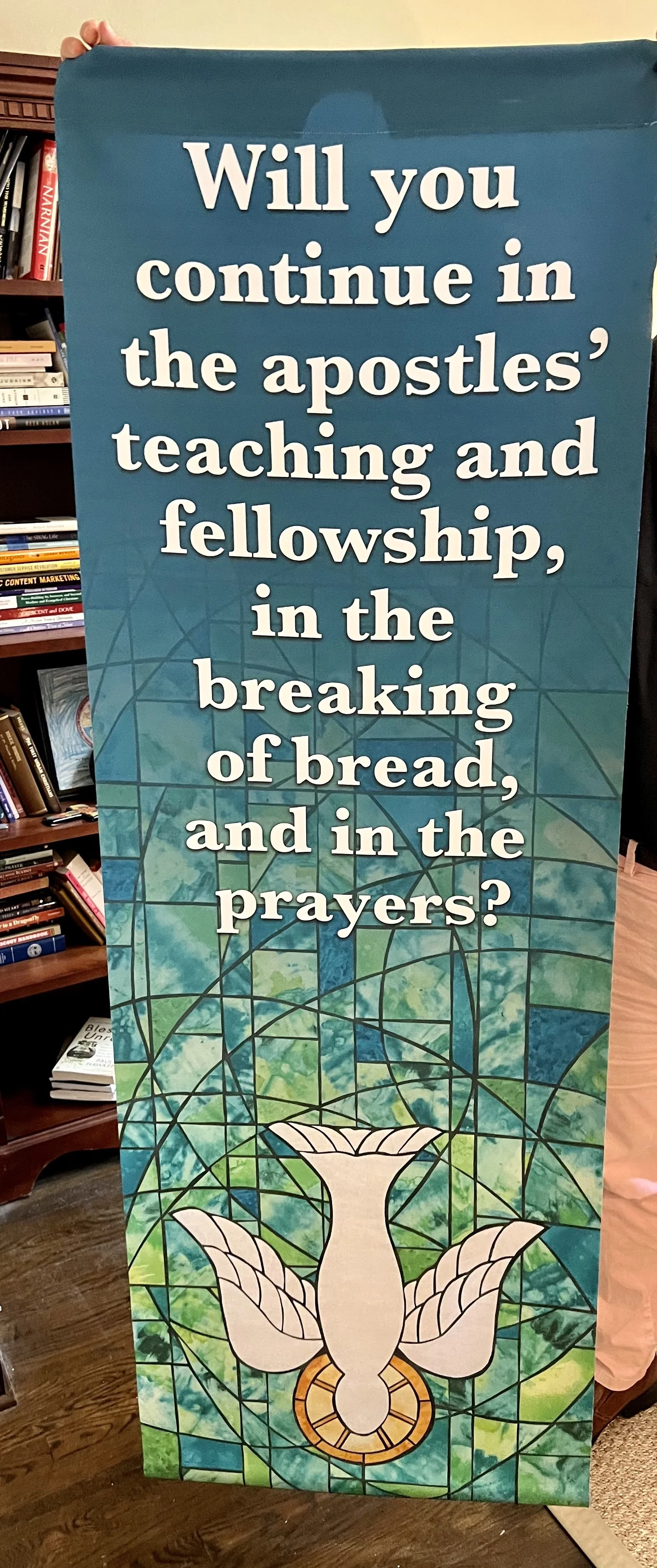
Maybe it is as simple as the book of Acts – learn, gather, pray. We shouldn’t diminish the power of our worship, of prayer, and the studying of Scripture. Saint Stephen’s might have a small church feel, one of the benefits of multiple worship services, but we are a corporate church with lots of programs. It can be challenging sometimes to navigate community, and to figure out just what is necessary for our own growth in our faith and love of God. Today is a reminder that sometimes the busyness of the programs doesn’t matter. Just showing up to pray and learn does. I hope I’ll see you Sunday (the schedule changes to 7:45 a.m., 9:00 a.m., 11:15 a.m., and 5:00 p.m.) and I’ll trust that’s enough.
John+
Questions for Self-Reflection: If you were to pick a mission statement for the church, what would it be? Does the Acts vision miss anything you think is necessary? Did you know the informal vision of Saint Stephen’s before? Does it make sense to you?
Daily Challenge: Learn, gather, pray. Right these three things down on an index card and next to each one, write, how you commit to doing it. Place the card in your purse or wallet as a reminder.

The Eleven - July 29
Daily Reflection for July 29, 2022
Today’s Readings: Psalm 33:1-5, 20-21; Esther 12:10-16; Romans 12:9-13; Luke 10:38-42
Today’s Reflection
O God, you poured your Spirit from on high to bless and summon these women, who heard the strength of your call: Equip, guide, and inspire us with wisdom, boldness, and faith to trust you in all circumstances, hear you preach new life to your church, and stretch out our hands to serve you, as you created us and redeemed us in the name of Jesus Christ, who lives with you and the Holy Spirit, one God everlasting. Amen. (Collect for the Commemoration of the First Ordination of Women to the Priesthood in Episcopal Church, July 29, 1974, from A Great Cloud of Witnesses)
Forty-eight years ago, on July 29, 1974, at the Church of the Advocate in Philadelphia, the very first women were ordained to the priesthood in the United States. Those eleven women, and it’s important that we take a moment to remember their names—Merrill Bittner, Alla Bozarth-Campbell, Alison Cheek, Emily Hewitt, Carter Heyward, Suzanne Hiatt, Marie Moorefield, Jeanette Piccard, Betty Schiess, Katrina Swanson, and Nancy Wittig—are now known in the history of the Episcopal Church as “The Philadelphia Eleven.” One of the Philadelphia Eleven, Alla Bozarth-Campbell, in her book Womanpriest: A Personal Odyssey, included a poem she composed that captures the context in which her ordination occurred:
Incomplete, they call us, unrecognizable.
Because we are eleven
and not the Magic Twelve
of your chosen few?
Because we are female…
And not important enough
to mention in Matthew,
Mark, Luke, or John,
our Hebrew sisters
present at your First Feast?
Even after the Eleven were ordained, they continued to face barriers to living into the ordained ministry to which they had been called. Because the General Convention of the Episcopal Church had not yet revised the wording of the church canons to include all, regardless of gender, many called their ordination invalid. It wasn’t just these eleven women who I consider to be in the “great cloud of witnesses” that opened the door to women, like me, to be ordained as priests. Four bishops, whose names also deserve to be remembered: Bishop Daniel Corrigan, former suffragan bishop of Colorado; Bishop Robert L. DeWitt, former bishop of Pennsylvania; and Bishop Edward R. Welles II, Manset, Me., retired bishop of West Missouri, and the Rt. Rev. Antonio Ramos, Bishop of Costa Rica.
These bishops were part of the church establishment but were willing to use their places of privilege to promote equal opportunity for women to serve not only as lay people and deacons, but also as priests in the Episcopal Church. Bishop Ramos, as documented in a July 31, 1974, press release found in the Archives of the Episcopal Church, said that this ordination: “stands as a prophetic witness on behalf of and for the oppressed.” He added that the ordination of the eleven women can “be characterized as an act of disobedience, ecclesiastical disobedience on our part, willfully done to abolish a system of canon law which is discriminatory, and which can no longer stand the judgment of the liberating Christ.”
The preacher at the ordination service was the vice president of the House of Deputies, Dr. Charles Willie, who “said that he participated in the service ‘not because I wanted to speak out but because I could not remain silent.’ Dr. Willie compared the event to the civil rights movement. “It was an unjust law of the state,” he said, “that demeaned the personhood of blacks by requiring them to move to the back of the bus, and it is an unjust law of the church which demeans women by denying them the opportunity to be professional priests.” However, he said, the ordination must be celebrated “not as an event of arrogant disobedience but as a moment of tender loving defiance.” A few weeks later, when the House of Bishops declared the women’s ordinations invalid, Dr. Willie resigned his post as vice president of the House of Deputies in protest.
Dr. Willie, as an African American man, was himself in a group long marginalized in the Episcopal Church as in the rest of U.S. society. I appreciate his prophetic witness, his willingness to stand up and be counted, his willingness to speak out against the “institutional sins” of the Episcopal Church in his time:
As a priest in the Episcopal Church, I continue to be grateful for the great cloud of witnesses, not only the women who serve as lay leaders, deacons, priests, and bishops, but also for the great cloud of men and women who have supported all God’s people being able to fully live into their baptismal vows and, if called to do so, to prepare for ordination as well.
Becky+
Questions for Reflection
Whose lives and stories have inspired you to take bold steps in your faith and in pursuing your own call? Who might be inspired by your own faith journey?
Daily Challenge
You can read more of the Philadelphia Eleven here and learn more of a documentary film (still in production) about their experiences here.

“The Lord raised up for them a deliverer” – July 27
Daily reflection for July 27, 2022.
Today’s Readings: AM Psalm 72; PM Psalm 119:73-96; Judges 3:12-30; Acts 1:1-14; Matt. 27:45-54
My sister Wayles gave me a wall calendar for Christmas this past year. Sitting in our home office today, I realized I neglected to turn the page to July…just a few days shy of turning the page to August. The calendar is called Sister Acts, featuring pictures of nuns on the run, in the community, and in July’s photo, they are at a drive-in theatre, seated in a blue convertible, eating popcorn. My sisters and I grew up loving the nun-based movie, Sister Act, where Whoopi Goldberg is a performer wrapped up with some less-than-stellar characters. To protect her, she finds sanctuary in a convent and must set aside her flashy nightclub attire to vest as a “woman of the cloth”. It was quite a struggle for Goldberg’s character to adjust to the rhythms of setting aside personal wants as she was called into a life of service and prayer with the other nuns and postulants for her protection from the mob.
While this Hollywood storyline spawned a movie, a sequel, and a musical, the tension is so relatable. How are we to live lives faithful to God, amid the distractions and temptations around us? In the Book of Judges, we read of this in a different setting: the Israelites living in the ancient Near East, surrounded by different people groups and mores. Time and again, a cycle of faithfulness arose: “the Israelites did what was evil in the sight of the Lord, forgetting the Lord their God, and worshipping” idols and false gods. Then, the anger of God was stirred against Israel and a punishing act happened to them – generally a new leader of the land took over and they would be subjected to hardship. After a period of time, the Israelites remembered their roots and called out to the Lord for help – and God raised up a deliverer for the Israelites. Hence the name of the book of the Bible: Judges. God raised up leaders to judge and guide the Lord’s people and to influence the temporal leaders of the day, so that the people of the land were protected and cared for.
God answered the cries of the Israelites in distress by preparing another person to deliver them. That holy response time took more than a moment or three. Sometimes the road of faithfulness appears to be winding and without end. And it is. One of the messages in our Holy Scripture today is that God desires our calls for help and our attention. It is in crying out that we return our gaze upon the Lord our God, and away from the screens and mindsets that separate us from the life and hope of Yahweh. And God is faithful to us, preparing others to be guides and tellers of truth along the way.
Katherine+
Questions for Self-Reflection:
When have you cried out to God for help?
Who is someone that speaks truth to you, even when it is hard to receive?
Daily Challenge:
What kind of judge would God send here in 2022? What would that person, imbued with the Lord's preparing love, relate to you to re-center where you are? What about your family? What about your community?
Be honest with yourself. Pray about it. Write down what comes up for you.

The Future is Hopeful - July 25
Daily Reflection for July 25, 2022
Today’s Readings: AM Psalm 56, 57, [58]; PM Psalm 64, 65; Joshua 24:16-33; Rom. 16:1-16; Matt. 27:24-31
"To be hopeful in bad times is not just foolishly romantic. It is based on the fact that human history is a history not only of cruelty, but also of compassion, sacrifice, courage, kindness.
What we choose to emphasize in this complex history will determine our lives. If we see only the worst, it destroys our capacity to do something. If we remember those times and places—and there are so many—where people have behaved magnificently, this gives us the energy to act, and at least the possibility of sending this spinning top of a world in a different direction.
And if we do act, in however small a way, we don't have to wait for some grand utopian future.
The future is an infinite succession of presents, and to live now as we think human beings should live, in defiance of all that is bad around us, is itself a marvelous victory."
My friend Kat shared this Howard Zinn quote from her weekly James Clear (Atomic Habits) e-news which I find profoundly hopeful. I have been thinking about it in light of this morning’s Gospel reading. “When Pilate saw that he could do nothing, but rather that a riot was beginning, he took some water and washed his hands before the crowd.” This might be the most ludicrous line in all of Scripture. Does Pilate really believe that he could do nothing? How does the man who came to Jerusalem and condemns Jesus to death wash his hands before the crowd? How can he believe he is not a part of the story?
The greater question for all of us, is what is our own role in this monumental mess we have made of the human life? The great paradox of human life is both the tragedy and hopefulness and beauty of the human existence. There can be poverty, war, famine, systemic injustice, failure to care for the planet and her resources, and yet there is profound hope. Each turn of the radio is creativity. Each book or typed sentence, or scribbled piece of poetry, is a chance to create something new. Each act of compassion, a meal served, or hand offered, is an act of resistance to what could be. Do we really get to wash our hands of the failings of humanity? Or do we get to be a part of the other side of human history?
The great gift of the Eucharist is we first acknowledge the human mess we have made. We don’t get to wipe our hands clean but instead place ourselves in the story of God’s salvation. And then we can do something about it. The prayer that is often used at our 5 pm Celtic Service following Communion is as follows:
Lord Jesus Christ,
you have put your life into our hands; now we put our lives into yours.
Take us, renew us and remake us.
What we have been is past; what we shall be, through you, still awaits us. Lead us on. Take us with you.
The future is hopeful. Maybe Pilate forgot that destroying his capacity to do something. May God lead us on us. May Christ take us with him. And may it be a marvelous victory.
John+
Questions for Self-Reflection: What are some of your memories of people ‘behaving magnificently?’ Who are the people who are inspirations to you?
Daily Challenge: Take one action (today and not tomorrow) as a response to one of the issues that weigh heavy on your heart.

Of Boldness and Boasting - July 22
Daily Reflection for July 22, 2022
Today’s Readings: AM Psalm 40, 54; PM Psalm 51; Joshua 9:22-10:15; Rom. 15:14-24; Matt. 27:1-10
Today’s Reflection
I myself feel confident about you, my brothers and sisters, that you yourselves are full of goodness, filled with all knowledge, and able to instruct one another. Nevertheless, on some points I have written to you rather boldly by way of reminder, because of the grace given me by God to be a minister of Christ Jesus to the Gentiles in the priestly service of the gospel of God, so that the offering of the Gentiles may be acceptable, sanctified by the Holy Spirit. In Christ Jesus, then, I have reason to boast of my work for God. For I will not venture to speak of anything except what Christ has accomplished through me. Romans 15: 14-18a
Oftentimes, confident people are misunderstood. Other times, confident people are questioned disliked because those around them see that, perhaps, they are unduly confident or that the source of their confidence is problematic somehow. Sometimes, we might even find humor in those who possess confidence that is out of proportion to their abilities and who, as a result, misread the situations in which they find themselves.
When I read today’s passage from Romans, scenes and snatches of dialogue from the U.S. version of The Office came to mind—in part because my daughter was watching multiple episodes of The Office just last evening. In nearly every episode I have seen, a key source of the humor comes from two characters, Michael Scott (played by Steve Carrell) and Dwight Schrute (played by Rainn Wilson). What makes Michael and Dwight funny, on their own but especially when they interact, is that both are very confident, often unduly so, in themselves. Much of the humor of The Office comes from how the other, more balanced characters (Jim, Pam, et al.) perceive them and respond to them, especially in their biggest, most out-there moments of egotism. And yet, we also find ourselves, against our better judgment sometimes, pulling for Michael or Dwight in a similar spirit as we might root for Don Quixote in some of his outlandish, windmill-fighting adventures.
Over the years, I have been drawn to the voice of Paul in his letters to his friends and supporters scattered around the Mediterranean region. More than anyone else in the Bible, I feel like I have been able to get to know Paul as a person through his letters. Yes, Paul has many flaws, of which he freely admits—and yet he also comes across as very confident in himself and the abilities God has given him. Some readers of Paul find this confidence to be over the top and frustrating—to them, his self-confidence is off-putting and detracts from his being a good messenger of the Good News.
However, these readers are not reading Paul’s letters closely enough. At multiple points in his letters, Paul acknowledges that the source of his confidence is the grace and love given him by God. We hear this in today’s passage from Romans 15. Paul feels “confident” in his friends because of they are “are full of goodness, filled with all knowledge, and able to instruct one another.” And he acknowledges that “on some points I have written to you rather boldly.” But ultimately what is the source of Paul’s boldness and the confidence he places in his friends? Paul speaks boldly “because of the grace given me by God to be a minister of Christ Jesus to the Gentiles in the priestly service of the gospel of God.” As he argues convincingly, “In Christ Jesus, then, I have reason to boast of my work for God. For I will not venture to speak of anything except what Christ has accomplished through me.”
As Paul declares elsewhere, in his letter to the Galatians: “May I never boast of anything except the cross of our Lord Jesus Christ, by which the world has been crucified to me and I to the world” (Galatians 6: 14).
Becky+
Questions for Reflection
Recall a time when you boasted about something not that you had done but on something good you observed or experienced that was clearly a glimpse of God’s grace and love. How does boasting about God and his creation and ongoing presence with us in the world feel different than boasting of something for which you are giving yourself the credit?
Daily Challenge
If you would like to reflect further on boasting, listen to this recent sermon, “May I Never Boast,” given by the Rev. Dr. Sam Wells at St. Martin-in-the-Fields, London, on July 3, 2022. It begins around the 26:50 mark.

Watching from a Distance - July 20
Daily reflection for July 20, 2022.
Today’s Readings: AM Psalm 119:49-72; PM Psalm 49, [53], Joshua 8:30-35; Rom. 14:13-23; Matt. 26:57-68
Violence is hard for me to bear in recent days. Since the shootings at Saint Stephen’s, imagery of interpersonal harm is upsetting. There is a television show Sam and I are watching on Hulu called “The Old Man”. It is exciting, fascinating, and sometimes violent. In order to get through some scenes, I turn my head away or cover my eyes. I know that this is a side-effect of trauma. It is too painful to absorb the hurt.
In today’s gospel reading from Matthew, in which Jesus is being tried before Caiaphas the high priest. Jesus refuses to answer the calls for his testimony. The excerpt for today ends with Jesus being struck in the face as someone demands, “Prophesy to us, you Messiah!” At first blush, I thought, “Nope!” and moved past this scripture to reflect on another piece of the Bible.
And yet here I am, writing about what I yearn to avoid. Here’s what I am wondering as I read Matthew 26 today: Peter must have been traumatized as he hung back and watched from a distance as Jesus, the Son of Man, was taken into custody, badgered, and beaten. What heavy feelings of guilt and remorse he carried around for the remainder of his days in ministry.
Peter was forever changed by his experience shadowing Jesus. He was a survivor in that surge of persecution. Did he wish he had been captured, too? How did he move through the regret? Who comforted him when he felt completely devastated? Did Peter rehearse any verses from Psalm 119 as he sat in horror? Several verses (65-68) resonate in such a space of inner turmoil:
O Lord, you have dealt graciously with your servant,
according to your word.
Teach me discernment and knowledge,
for I have believed in your commandments.
Before I was afflicted I went astray,
but now I keep your word.
You are good and you bring forth good;
instruct me in your statutes.
Sometimes it takes others’ words of faithful prayer to bring peace in discomfort – like the petitions in Psalm 119. And sometimes, we get to let yesterday rest and make different decisions moving forward. Let us prayerfully do the next right thing today.
Katherine+
Questions for Self-Reflection:
Think of a time that someone really let you down. What feelings and thoughts remain about that person?
Think of a situation when you let someone else down. How did you react next?
Daily Challenge:
What does letting go of disappointment look like for you today? Spend a few minutes journaling about a scenario where you felt deeply disappointed, yet the solution feels far away. Pray to God for grace to enter this space of discomfort. Pray through the verses of Psalm 119 appointed for today.

Asleep with an Invitation to Wake Up - July 18
Daily Reflection for July 18, 2022.
Today’s Readings: AM Psalm 41, 52; PM Psalm 44: Joshua 7:1-13; Rom. 13:8-14; Matt. 26:36-46
I get the sense Jesus is not only frustrated but disappointed that his friends were unable to stay awake through the evening in the Garden of Gethsemane. Not once, but three times he comes back to find them sleeping. Jesus has gone to the garden, not only to grieve, but the scriptures say to ‘be agitated.’ I’m not sure I have noticed those words before, but grief and agitation seem like good roommates today. Jesus has to tell his friends three times and they still can’t get it straight, stay away even for an evening. I’m not surprised he is agitated. They just don’t get it.
It seems pretty straightforward to the reader who sympathizes with Jesus, coming back to find his friends asleep as the story unfolds. But what happens when find ourselves in the place of the disciples, being awakened to a friend’s grief and agitation having once again failed to meet their expectations? Is the Gospel a warning or a reminder of what will happen with a vision for a kingdom way to live that is always a possibility and yet just out of touch from reality?
There are two realities that this can point us to that can be especially helpful in a community that has faced a tremendous amount of grief and loss. First, we will fail to meet the expectations of others. We will find ourselves not quite fully understanding the depth of pain that others are living with at this present time. It may even feel to others that we are asleep to the grief that others are facing. It’s oddly comforting that the narrator reminds us that the disciples’ “eyes were heavy.” They have done too much to stay awake.
But being asleep makes an assumption – that we can be awakened. I am finding awakened a helpful world. What God is asking us is not to be consumed or taken over by a feeling of emotions only to be aware of it and attuned to it. This assumes a listening posture, an awareness that previously was not there, and some generosity around listening. We can both be unaware of the pain around us and be open to receiving the pain and grief.
Maybe this is all good news. We aren’t capable of fully comprehending the depth of pain in others’ lives. And yet every day is an opportunity to listen, to find ourselves invited to be awakened once again. So, “Get up, let us be going.” It’s a daily invitation into a deeper relationship with each other and God. We don’t have to have it all figured out, only be attuned to respond when God wakes us up.
John+
Questions for Self-Reflection: Where are the grieving people in your own life? How have you failed to recognize their own pain and when have you been invited to wake up?
Daily Challenge: If you are interested in learning about active listening, here is an article that has some tools for listening.

'Life is so beautiful. Life is so hard.' - July 15
Daily Reflection for July 15, 2022
Today’s Readings: AM Psalm 31; PM Psalm 35; Joshua 4:19-5:1,10-15; Rom. 12:9-21; Matt. 26:17-25
Today’s Reflection
Back in May, I printed out two copies of a simple yet beautiful little poster—one for my refrigerator at home and one for my bulletin board at work. The poster is, in fact, a miniature version of a mural that was painted this spring on the side of a building in Durham, North Carolina. On it are just eight words, along with some beautiful flowers and leaves interspersed amongst the words: “Life is so beautiful. Life is so hard.” These are words from Duke professor and author Kate Bowler, someone whose life story and writing I have found especially encouraging since I began reading her books two years ago.
Some of you also have read her books Everything Happens for a Reason (and Other Lies I’ve Loved), No Cure for Being Human, and Good Enough—and some of you read them with us in one of our Saint Stephen’s book groups. Others of you have been encouraged by her podcast, Everything Happens. (The rest of you have heard me quote from these in at least several sermons and Daily Office reflections.)
Maybe we think we would like the poster better if it just had the first four words, “Life is so beautiful.” But based on my own life experiences, I know that if we leave off after the first four words then the poster wouldn’t really ring true and wouldn’t be nearly as encouraging. It’s only when we add the second four words, “Life is so hard” that the poster goes from being syrupy sweet to being both realistic and encouraging.
The focus of Bowler’s Everything Happens Project, based at Duke, is to encourage the practice of everyday empathy. It’s a perspective on life together that holds in tension the beauty to be found in encouraging one another through everything that happens—the hard things, the things we will never understand, the things for which we will never come up with a ‘good reason’ for why they happened (or are happening) to us or to those we love or to the world around us. Let’s be real: $#!% happens. Clearly. But when it does, we must keep showing up for each other—and we know that God, in God’s great love for us, keeps showing up. God is with us. Or as we read today in Psalm 31:
But as for me, I have trusted in you, O Lord. I have said, “You are my God. My times are in your hand; rescue me from the hand of my enemies, and from those who persecute me. Make your face to shine upon your servant, and in your loving-kindness save me.” (Psalm 31: 14-16)
A big part of how God shines God’s face on us is through us shining our faces on one another. How do we shine our face on one another? What does this mean?
Here’s what Kate Bowler learned as she began her ongoing battle with cancer at age 35 and in the several years since: “What I realized when I needed so much was that it was those everyday acts of compassion that were going to carry me. Once I could see it in my own life, I saw it everywhere—in the grocery store, and in the community, and at work, and at the hospital—is that we really do need each other in order to just face the reality of how hard life is. I found myself repeating the same thing over and over again: that life is so beautiful, and life is so hard—for everyone. Everyday empathy allows us to remember the things our culture forgets: that individualism can never carry us, it can never allow us to build bridges that we need to actually carry our lives. Everyday empathy reminds us that we belong to one another.” Which sounds a lot like what we read today in Paul’s letter to the Romans:
Let love be genuine; hate what is evil, hold fast to what is good; love one another with mutual affection; outdo one another in showing honour. Do not lag in zeal, be ardent in spirit, serve the Lord. Rejoice in hope, be patient in suffering, persevere in prayer. Contribute to the needs of the saints; extend hospitality to strangers. Romans 12: 9-13
Seeing the words “Life is so beautiful. Life is so hard” every day in my kitchen and in my office reminds me of what is most important and what is most true. Life is both beautiful and hard—there’s no getting around the fact that it is both. But what makes life beautiful, even when we are constantly challenged and confused by the parts that are hard, is that God is with us (and we are with one another) and that will never change. Thanks be to God.
Becky+
Questions for Reflection
How have you experienced life being both beautiful and hard? How do you (or could you) picture God’s face shining on you when life seems especially hard?
Daily Challenge

Desert meditation - July 13
Daily reflection for July 13, 2022.
Today’s Readings: AM Psalm 38; PM Psalm 119:25-48, Joshua 3:1-13; Rom. 11:25-36; Matt. 25:31-46
While I was in seminary in Austin, Texas, Sam and I would go to this nursery and organic gardening center called The Natural Gardener. It was a remarkable piece of sprawling Hill Country nestled in the exponential growth of an urban mecca. The Natural Gardener embraced the hot sun of Texas, and the toll it could take on terrain, by balancing dusty pathways and drought-tolerant grasses with arrays of wildflowers. The gardens were a botanical haven, with an edible garden for kids to take snips of various herbs and lettuces, and staff to guide and invite them to do so. Josephine was four or five when we first went there, so the huge swing on long thick ropes grabbed her attention, as did the pasture with fickle goats and a reluctant donkey.
There were days in the white-hot summer we would drive the 30+ minutes out to this retreat, not to buy new plants – as we were renting the house we lived in. It was for survival…we needed a place to go to take a breath and a change in the rhythm of the week. On one of those days that had been tumultuous, I remember finding great refreshment at The Natural Gardener - not in the rainbow of floral designs and babbling brook, but as I wandered the dusty grey path, winding up a slow rise past dry tall grasses, old fences, and older trees toward small corners of shade. I let go of the troubles upon my shoulders and the tears waiting to pour down my cheeks. It felt like time slowed down as I ambled and explored.
This old dirt path felt like it held the same power as a labyrinth, inviting me into prayer as I took one step at a time. On that day, I did not need the bright colors of flowers to entice or keep me; I stepped through the wild and untamed parts, sturdy and resilient. On that day, I needed to feel peace in the dust. For in that desert terrain, one drop of water yields life and growth and a burst of beauty.
A part of Psalm 119 is appointed for this afternoon or evening’s prayer time; verses 33 through 40 capture my attention as invitations to meditate and return to an emotional and spiritual center within oneself, with God’s help. The psalmist’s voice calls out in this prayer of direction to God:
“Teach me, O Lord, the way of your statues, and I will observe it to the end. Give me understanding, that I may keep your law and observe it with my whole heart. Lead me in the path of your commandments, for I delight in it. Turn my heart to your decrees, and not to selfish gain. Turn my eyes from looking at vanities; give me life in your ways. Confirm to your servant your promise, which is for those who fear you. Turn away the disgrace that I dread, for your ordinances are good. See, I have longed for your precepts; in your righteousness give me life.”
Notice the verbs used: teach, give, lead, turn, confirm, see. In this raw prayer for God’s refreshing guidance, life is hard. This is a prayer for God’s order to break in upon our messy, dusty life.
This hot July morning, I give thanks for this piece of Psalm 119, as I imagine rehearsing these words while walking the winding desert garden path in Texas. The waves of emotion parallel the turns and switchbacks of the maze of a labyrinth meditation. What a cleansing and centering experience that can be, to allow these ancient prayers to draw us nearer to God. Breathing, praying, being. Being self. Being with God. Being loved.
Katherine+
Questions for Self-Reflection:
Where is a safe and comfortable space for you to reconnect and recenter yourself? When have you done that kind of “reset” in the last month? What sounds and images bring you that sense of peace on a hard day?
Daily Challenge:
Go for a 10-minute mindfulness walk. Take your time. Listen for God guiding you, tending to you, refreshing you. Give thanks to God for the breath that comes into your body, and as you exhale, release those things that are unresolved, painful, and weighing you down.

How much more will their full inclusion mean! - July 11
Daily Reflection for July 11, 2022.
Today’s Readings: AM Psalm 25; PM Psalm 9, 15; Joshua 2:1-14; Rom. 11:1-12; Matt. 25:1-13
“Now if their stumbling means riches for the world, and if their defeat means riches for Gentiles, how much more will their full inclusion mean!”
A simple statement from Paul to the Romans. Paul is trying to show his Jewish brothers and sisters that God’s extension of love is beyond them, a message of love and inclusion to the Gentiles. The very Gentiles who have killed prophets, destroyed altars, and left his friends and family feeling utterly alone. A timely lectionary indeed. When faced with hardship, inclusion is the only answer.
Paul continues, “But if it is by grace, it is no longer on the basis of works, otherwise grace would no longer be grace.” Grace upon grace upon grace. Oddly, it is the stumbling of the Gentiles that teaches Paul about the true power of grace. Without utterly messing up, they wouldn’t understand the true power of God’s inclusion and grace.
Maybe love is similar, where we have to lose it all in order to understand the true value of love, the power of love, the hope of love, and what God has intended for each of us. I wish more than anything that our community hadn’t been thrust through this ordeal, that the senseless loss of life wouldn’t have become our story. And, I can honestly say, that I have a new understanding of grace, inclusion, and love that I wouldn’t have understood before.
God is calling us into the full body of Christ, where all are welcome. And it is the most beautiful community I have ever witnessed. “Now if their stumbling means riches for the world, and if their defeat means riches for Gentiles, how much more will their full inclusion mean!”
John+
Questions for Self-Reflection: What are your stumbling blocks? Where have you experienced grace recently? How have you experienced inclusion?
Daily Challenge: Consider hosting some sort of gathering that brings different people together. It could be a work lunch, happy hour, or coffee. Set parameters so that people understand the purpose and feel safe. If you do this, I would love to know about it later.

Encouraging One Another with Love - July 8
Daily Reflection for July 8, 2022
Today’s Readings: Deut. 31:7-13,24-32:4; Psalm 119:33–40; Acts 18:1–4, 18–21, 24–28; Luke 24:28–35
Today’s Reflection
God of grace and might, who gave to your servants Aquila and Priscilla gifts of zeal and eloquence to make known the truth of the Gospel: Raise up, we pray, in every country, heralds and evangelists of your kingdom, so that the world may know the immeasurable riches of our Savior Jesus Christ; who lives and reigns with you and the Holy Spirit, one God, now and for ever. Amen. (Prayer for the Feast Day of Priscilla and Aquila)
Many accounts of Paul’s mission and ministry as he traveled around the Mediterranean and Near East depict him teaching in synagogues or defending himself in the public forum. But even more important to Paul’s mission was the way he invested time in people and, in turn, built ongoing relationships that nurtured them in their faith.
As we read in Acts 18, when the consul Gallio dismissed Paul’s case, Paul didn’t just set off for the next place. Instead, he stayed “for a considerable time,” which scholars tell us was about 18 months. While he said his farewells to all the believers there, two of the believers in whom he had invested his time and care in there, Priscilla and Aquila, decided to travel on with Paul and help him spread the Gospel elsewhere. Once they reached Ephesus, Paul visited the local synagogue to do some teaching amongst those gathered there. But when they asked him to stay, he turned them down, saying that “I will return to you, if God wills,” and he continued on toward Antioch, Galatia, and Phrygia, “strengthening all the disciples.”
But Paul did not leave the believers in Ephesus without support. Priscilla and Aquila stayed on to nurture the Ephesian believers in their shared faith. The time Paul had invested in developing Priscilla and Aquila meant that they were now equipped to encourage others in their faith. And that is exactly what we find them doing in Acts 18: 24-28.
Ephesus, as a crossroads of trade in the ancient world, attracted people from all around the Mediterranean region. Another person who made his way to Ephesus was Apollos, who hailed from Alexandria, Egypt, a major center of learning in the ancient world. Luke describes Apollos as “an eloquent man, well-versed in the Scriptures” who “had been instructed in the Way of the Lord.” Apollos “spoke with burning enthusiasm and taught accurately the things concerning Jesus.”
However, we also learn that, while Apollos was a well-educated man and a gifted orator, his formation was not complete, as he “knew only the baptism of John.” In other words, Apollos’ heart was in the right place and he had learned some important things, but there was still room for growth as Apollos continued to be formed as a believer.
Enter Priscilla and Aquila. As they settled into Ephesus and getting acquainted with the community of believers there, they heard this enthusiastic new believer, Apollos, speaking with great boldness and passion about his faith. And what they recognized is that Apollos needed to grow in his knowledge, so that what he shared with others was not just passionate teaching, but also correct doctrine. Apollos knew some of the story, but Priscilla and Aquila, as believers a bit further along in their learning, saw that Apollos still needed to hear the rest of the story.
But instead of calling Apollos out in public, sparking some kind of contentious public debate about the baptism of John versus the baptism of Jesus, Priscilla and Aquila made a more enlightened move: “they took him aside and explained the Way of God to him more accurately.” And then later, when Apollos felt ready to travel on to Achaia, in Corinth, his fellow believers in Ephesus “encouraged him and wrote to the disciples to welcome him.”
Paul invested his time in building relationships with and teaching the believers in Corinth, among them Priscilla and Aquila—who in turn invested time in building relationships with and teaching believers in Ephesus, including Apollos. And once Apollos was nurtured along to a more mature point in his faith, he continued the cycle—by returning to Achaia, where he, in turn, “greatly helped those who through grace had become believers… showing by the scriptures that the Messiah is Jesus.”
Each time a follower of the Way of God takes time to invest time in another pilgrim on the way, the faith of both will be strengthened. Faith is not something we are meant to experience by ourselves. Faith is something we are meant to experience together, helping to nurture one another as we learn together. Taking someone aside and investing that extra time and care goes a long way toward encouraging them to have a faith that continues to grow—and one that they, too, will want to share with someone else.
Becky+
Questions for Self-Reflection
Can you recall a time when someone took you aside to check on you or help you learn something new? How did it feel to have someone notice you and take the time to care for you in that moment?
Daily Challenge
Next time you are in a discussion—whether in-person or online—and hear someone saying things you believe are incorrect or unhelpful to others, pause. After the pause, then find a way to connect with the person away from the main discussion forum so that you can have a one-on-one conversation about the points on which you differ.

Authentic vulnerability - July 6
Daily reflection for July 6, 2022.
Today’s Readings: AM Psalm 119:1-24; PM Psalm 12, 13, 14; Deut. 1:1-18; Rom. 9:1-18; Matt. 23:27-39
Jesus said, ‘Woe to you, scribes and Pharisees, hypocrites! For you are like whitewashed tombs, which on the outside look beautiful, but inside they are full of the bones of the dead and of all kinds of filth. So you also on the outside look righteous to others, but inside you are full of hypocrisy and lawlessness.’
The imagery in the first couple of verses of Matthew appointed for today will not let me go. I am stuck on those whitewashed tombs. They are visually appealing on the outside, where people gather and remember with fullness and love. Once inside, one finds the space full of the detritus of death. What a stark and germane contrast Jesus provides, as he calls out the educated and influential spiritual leaders of the Temple to be authentic and vulnerable.
Authenticity sometimes means stopping to sit with someone in need, before finishing a chapel duty. Vulnerability looks like naming (and feeling) when there is uncertainty or pain, and then asking for help. This work of paying attention to reconcile – and not always resolve – the messiness within our hearts and around our communities is the holy and hard work we are called to do together. It is an effort grounded in prayer. It is a rhythm with roots in the movement of the psalms. Sometimes we will look beautiful and pleasing. Other times, this work of vulnerable authenticity will present as broken and sad. Because sometimes each of us is beautiful, and broken, and blubbering. Then, we find spaces of rest and release, laughter and hope.
Over the last nine days, I worked with a devoted and lovely team from Saint Stephen’s as we presented the daily program to junior high-aged teens at Camp McDowell. As the session included Independence Day, our theme for the week was interdependence. We hoped for the campers to grasp that we are never doing life alone and independently. The Israelites wandered through the deserts of Egypt with the cloud of God’s presence always nearby. They relied on one another, and upon the Lord. Jesus performed miracles for and with others – not for his own pleasure. Mary Magdalene went to the tomb to see her friend Jesus – and a gardener appears, to console and encourage her. She ran to the disciples to share the news that Jesus had risen from the dead. Those witnesses of faithfulness draw us into trusting God and one another.
By living life as interdependent Christians, by design we remain authentic and vulnerable, because we need one another, just as we need God. Jesus is with us in the messy collage that is daily life – in the midst of joy and heartache.
My dear ones, I pray that you are staying vulnerable and authentic. Whitewashing our lives only shortchanges the fullness of joy that God desires for each of us. I challenge you to share more openly with someone you trust, feel more deeply for those around you, and pray for Jesus to be with you in those moments when it would be easier to do something different. And ask for help – from a friend, from a professional, and from God.
Katherine+
Questions for Self-Reflection:
When are you most likely to whitewash a part of yourself or your history?
What people and practices in your daily life keep you grounded and vulnerable?
Daily Challenge:
Spend five minutes today to journal about what a call to being vulnerable and authentic looks like for you today. Think about who and what you need to help you venture into this meaningful and hard space.

Love in Action, Not Words - July 4
Daily Reflection for July 4, 2022.
Today’s Readings: AM Psalm 1, 2, 3; PM Psalm 4, 7, Num. 32:1-6,16-27; Rom. 8:26-30; Matt. 23:1-12
In March of 2020, our clergy began writing daily reflections based on the daily cycle of readings within the Episcopal Church, a practice that became the spiritual grounding for my life in the midst of wrestling with a pandemic and its influence on what it meant to be part of a faith community. We reduced that practice to writing three times a week, one reflection by each full-time clergy member, a few months ago, with a desire to make the practice one that could live on in perpetuity. Reading scripture daily and taking time to meditate on its meaning and influence in my own life has not only been life-giving but has personally helped sustain me through the most challenging of years.
Two weeks ago, we took a two-week break to respond to the heightened and pressing ministry needs of a mass tragedy in our community which also means that many of you are reading this email for the very first time, brought to Saint Stephen’s in search for how our faith can help us process or live with such unfathomable pain and grief in a way that is hopeful and transformative. Personally, as the Rector of the church, the path has seemed clear so far on how to respond to the tragedy at Saint Stephen’s – with love and hospitality. The mirror image of the Last Supper around the event that took place on June 16 has provided such a hopeful image to me of what it means to live out my faith. It is simple. Always welcome with love, even at the cost of life. I am not suggesting this is easy to do, in fact, it took three of the most faithful people I have ever met to sacrificially model it, but I now know what I am supposed to do, to strive for, a model for what my life can be.
However, I have struggled with how to respond in love to much of what seems to be playing out in our national discourse, especially in a place that has deeply tried to hold people together who have competing views. If we are to welcome people at the cost of our life, what does this mean for people who have views that we think are reprehensible, or destructive to the well-being of those who are marginalized? How do we welcome people who might think our own views are the very same as we think about a different point of view? How does radical welcome, love, and acceptance play out at such a time as today?
In today’s Gospel, we find ourselves in a discourse with Jesus and the Pharisees, Jesus pointing to the hypocrisy of the religious community gathered whose actions never seem to mirror the words they offer. At a first glance, it could be easy to hold up faith communities whose moral outrage at the behaviors and practices of some have highlighted just how hypocritical the religious often are. Many of us Episcopalians are quite good at this practice – being outraged at the ultra-religious.
But the gift of reading and reflecting on Scripture daily in our life is that it should always point to our own growth. Where I am in this story? Could today’s readings be a reminder that my own words, what we have to speak to into the very common life of our world today is limited in its potential, but how we act and respond is what matters? “Then Jesus said to the crowds and to his disciples, ‘The scribes and the Pharisees sit on Moses’ seat; therefore, do whatever they teach you and follow it; but do not do as they do, for they do not practice what they teach. (Matthew 23:1-3).
What do I say about the world today, the environmental, social, and medical implications for the wellbeing of our world? I don’t know. But I do know how to act. Maybe, it is to care more tenderly for the earth, to work more to improve the lives of the poor and those faced with impossible decisions, and to be better about sharing what I can. And I will trust that God’s word will shine through at the appropriate time.
John+
Questions for Self-Reflection: What challenges and dilemmas keep you up at night? What do you disagree with that comes from your own faith tradition and where have you changed in your opinion over time? How can you act in love as opposed to speaking in love?
Challenge: Find one actionable step of something that you can practice that improves the lives of others that aligns with something you believe and yet have never done before.

Hearts Broken Open - June 17
Daily Reflection for Friday, June 17, 2022.
Resources for Suffering, Grieving, and Healing
from Saint Stephen’s Christian Formation
The Rev. Dr. Malcolm Marler, “Good Grief: How to Survive It or Help Someone Through It”
The Rev. Dr. Vincent Pizzuto, “A Cry of Dereliction: Lamentation and Resurrection in the Gospels”
Will Kynes, PhD, “How Biblical Lament Helps Us Respond to Suffering”
Amy Cottrill, PhD, “Resilience in the Midst of Suffering: Perspectives from the Psalms”
The Rev. Dr. Sam Wells, “Does God Heal?”
The Rev. Steve McPeek, “The Gift of Grief and the Fellowship of Suffering”
Today’s Readings: AM Psalm 88; PM Psalm 91, 92; Num. 13:1-3,21-30; Rom. 2:25-3:8; Matt. 18:21-35
Today’s Reflection
This is another day, O Lord. I know not what it will bring forth, but make me ready, Lord, for whatever it may be. If I am to stand up, help me to stand bravely. If I am to sit still, help me to sit quietly. If I am to lie low, help me to do it patiently. And if I am to do nothing, let me do it gallantly. Make these words more than words, and give me the Spirit of Jesus. Amen. (Prayer for Morning, Book of Common Prayer, p. 461)
As we begin this new day, we are waking up forever changed. As I write this on Friday morning London time (Thursday night, Birmingham time), two very beloved members of our Saint Stephen’s community have died in the most senseless and tragic circumstances, a shooting in our own church building. Another remains hospitalized. Still others who were present are now carrying the invisible, lasting wounds of trauma. All who knew them and who are at all connected with our church are impacted in innumerable ways.
This is a space that we associate with love and joy and community—wedding receptions, Vacation Bible School, bingo and movie nights, guest lectures, Sunday Forums, Wednesday night dinners, the ECW Tea. Now this same space will also be linked in our minds with a time of fear and chaos and sorrow. What are we to do? How are we to go on? As one of your priests, I do not know what to say in the face of all of this deep sadness, but I am praying for the words this morning as I write to you from far away—and looking toward being reunited to walk together through this time of collective grieving and healing.
As I look through the readings appointed for today, our psalm appointed is Psalm 88, which begins with these verses: “O Lord, my God, my Savior, by day and night I cry to you. Let my prayer enter into your presence; incline your ear to my lamentation.” These verses capture well the raw, vulnerable spirit of these recent hours for me and I expect for many of you as well. Our hearts are crying out. My mind and body are tired from lack of sleep, having learned of this at 1:30 a.m. London time and not sleeping since hearing word. My heart is tired from hearing of the shooting down of yet more innocent people—and all the more because these are these sheep of our very own fold.
And so, all I know to do right now to rest in God’s presence, crying out in the middle of the night and now in the beginning of the new day: How long, O God?
Lord have mercy.
Christ have mercy.
Lord have mercy.
In closing, I offer you what is coming up for me in these first hours of processing what has happened and what is giving me hope and reassurance in this time: Our hearts are surely broken—but in this suffering, our hearts are also broken open. The healing, saving love of Christ wells up inside each one of us, seeping through the cracks of our brokenness and suffering to refresh this dry land in need of this living water.
God is with us as we suffer, grieve, and heal—and we are with one another. Thanks be to God.
Becky+
The peace of God, which passes all understanding, keep your hearts and minds in the knowledge and love of God, and of his Son Jesus Christ our Lord; and the blessing of God Almighty, the Father, the Son, and the Holy Spirit, be among you, and remain with you always. Amen. Blessing of Peace (Book of Common Prayer, p. 339)
Arise, shine, for your light has come,
and the glory of the Lord has dawned upon you.
For behold, darkness covers the land;
deep gloom enshrouds the peoples.
But over you the Lord will rise,
and his glory will appear upon you.
Nations will stream to your light,
and kings to the brightness of your dawning.
Your gates will always be open;
by day or night they will never be shut.
They will call you, The City of the Lord,
The Zion of the Holy One of Israel.
Violence will no more be heard in your land,
ruin or destruction within your borders.
You will call your walls, Salvation,
and all your portals, Praise.
The sun will no more be your light by day;
by night you will not need the brightness of the moon.
The Lord will be your everlasting light,
and your God will be your glory.
Glory to the Father, and to the Son, and to the Holy Spirit:
as it was in the beginning, is now, and will be for ever.
The Third Song of Isaiah (Canticle 11, Book of Common Prayer, pp. 87-88)