
Daily Reflections based on Daily Lectionary of the Episcopal Church written by the clergy of Saint Stephen’s.

Getting ready is a process - February 10
Reflection for February 10, 2021.
Today’s Readings: AM Psalm 119:97-120; PM Psalm 81, 82; Isa. 59:15b-21; 2 Tim. 1:15-2:13; Mark 10:1-16
Do you ever (metaphorically) drag your feet getting ready in the morning? The delays in showering, dressing, and exiting the front door are not always because there is some existential dread about what meets you when you leave the house. Perhaps you put it off because there are other personal tasks that you need to attend to first, or you get distracted by a basket of laundry, or there is a news segment that gets you thinking about your dad, so you give him a call to discuss. Before you know it, you are not prepared and it is time to go…you are running late.
One of the messages in our Holy Scriptures that we hear repeatedly is to be prepared, to stay awake, to be alert. We hear it in the prophets’ words. Jesus as teacher prepares his followers, and all who will hear, about that final day when every knee will bow and every tongue will confess God’s sovereignty, ushering in a space of universal peace. Paul D. Hanson, Professor of Divinity Emeritus at Harvard Divinity School, writes that to be prepared for that day, we engage in the daily tasks ascribed in the guidance from one of the twelve minor prophets, Micah:
He has told you, O mortal, what is good;
and what does the Lord require of you
but to do justice, and to love kindness,
and to walk humbly with your God? (Micah 6:8)
In Isaiah 59, it is not we who are preparing, but it is God who is getting ready. And why? In the prophetic language found earlier in Isaiah, there is much encouragement around God’s promises ahead for restoration, if the Hebrew people would just be faithful and follow God. As my mom would say, “Straighten up and fly right.” Those divine promises were not immediately delivered. The people grew restless and weary. The critiques and attempts to shift social and political structures yielded little change. In this later portion of Isaiah (called third Isaiah), we see an emergence of more apocalyptic language, as the exilic Israelites yearn for “a more direct path to God’s reign” (Hanson). That comes through in verse 16 today:
He saw that there was no one,
he was appalled that there was no one to intervene;
so his own arm achieved salvation for him,
and his own righteousness sustained him.
What follows is the prophet’s description of how Yahweh prepares for a direct intervention into the lives and hearts of this world, for the purpose of expunging evil and infusing truth. God does not drag his feet or delay. And what does God do to get ready? Put on righteousness like a breastplate, salvation like a helmet, vengeance as the day’s outfit, and fury as the overcoat. Intense, huh?
It is more comfortable for us to lean into pastoral, comforting images of God’s mercy. How might we also accept that the righteousness and passion of God can be expressed in divine wrath – fury and vengeance? And how might we draw near to God, repenting from those evils that we have done, and those done on our behalf, so that as a people redeemed, we approach the feet of Jesus as the children of God, with our hearts focused on the daily task of doing justice, loving kindness, and walking humbly with God today, and every day.
-- Katherine+
Questions for Reflection
When have your words been lacking in truth? When have you seen someone else be less than forthcoming? How did you respond?
How are you preparing each day for a walk with God?
Daily Challenge
Meditate on what it means to prepare for receiving God by doing justice, loving kindness, and walking humbly. What in your life makes this hard? What makes it easy? Pick one obstacle that you work on removing for today, so that your spiritual connection with God might be less cluttered today.

Rekindling the Gift of God in You - February 9
Daily Reflection for February 9, 2021
Today’s Readings: AM Psalm 78:1-39; PM Psalm 78:40-72; Isa. 59:1-15a; 2 Tim. 1:1-14; Mark 9:42-50
Today’s Reflection
“I am reminded of your sincere faith, a faith that lived first in your grandmother Lois and your mother Eunice and now, I am sure, lives in you.” –2 Timothy 1:5
One thing I love about the letter Paul writes to Timothy, his precious son in the faith, is that when Paul thought of Timothy, he was “reminded of your sincere faith, a faith that lived first in your grandmother Lois and your mother Eunice and now, I am sure, lives in you.” Timothy had the faith required to follow Jesus and join with Paul in spreading the Gospel because of the faith that lived first in Timothy’s grandmother Lois and in his mother Eunice. Lois and Eunice shared their faith with Timothy by living out their faith in that “spirit of power and of love and of self-discipline,” which Paul is reminding Timothy to rekindle now that he is an adult and an apostle of Jesus.
Timothy’s grandmother Lois and mother Eunice remind me of some of my own forebears in the faith. Lois and Eunice remind me of my Granny and Granddaddy Bridges, who for decades were very involved members of the First United Methodist Church in the small town of Cuthbert, which is in southwest Georgia. Granny was a member of one of the ladies’ circles and a faithful choir member. Granddaddy regularly served as a greeter and usher.
Granny and Granddaddy prayed and read their Bibles and devotional books every day. When we visited, if I got up early enough in the morning, I might find Granddaddy sitting in his recliner reading his Bible and devotional, while I might find Granny reading hers up later in the evening. The faith that I have today is due, in part, to seeing the faith of my Granny and Granddaddy lived out in “a spirit of power and of love and of self-discipline.”
As Paul wrote to Timothy, his son in the faith: “I remind you to rekindle the gift of God that is within you… for God did not give us a spirit of cowardice, but rather a spirit of power and of love and of self-discipline.” That word “rekindle” is an important word to notice here. I also really like the way it’s translated in the ESV or English Standard Version of the Bible: “fan into flame the gift of God that is within you.” In order to turn away from a “spirit of cowardice” and turn toward a spirit of doing big things with God, we need a daily “re-kindling” of God’s gift living inside each of us.
So how do we go about keeping the fire of our faith kindled, of fanning it into flame, so that the light of Christ is not snuffed out, but is always shining within us and lighting our way? Or, as the apostles asked Jesus: How do we increase our faith? Paul, in this letter to Timothy, gives us an idea. In the NRSV version of 2 Timothy 1, Paul advises Timothy and his community to “Hold to the standard of sound teaching that you have heard from me, in the faith and love that are in Christ Jesus. Guard the good treasure entrusted to you, with the help of the Holy Spirit living in us.” I find the ESV translation to be even more clear: “Follow the pattern of the sound words [or: the healthy words] that you have heard from me.” In order to guard the “good treasure” entrusted to us by the Holy Spirit living in us, we are to follow the healthy pattern.
Once we decide we want to turn our lives toward following Christ, of being centered in him, we can then choose to keep the flame of our faith burning through committing to a pattern or rule of life that includes praying, learning, worshipping, and blessing others—and, of course, making time for rest so that we, and the fire of our faith, don’t burn out. For me, building both prayer and rest into my daily pattern of life fans into flame the spiritual energy necessary to drive the other elements of worshipping and learning, and then going forth and blessing others. What matters most is that we are always turning back toward God, making a bit of time and space to connect with God in the daily rhythm of life that God has given to each of us.
As you go forth into whatever life has in store for you today and in the days to come: “I pray that out of his glorious riches God may strengthen you with power through his Spirit in your inner being, so that Christ may dwell in your hearts through faith.”
—Becky+
Questions for Self-Reflection
Who has been a Lois or Eunice figure in your life? Are you (or could you be) a Lois or Eunice to someone else?
Daily Challenge
Listen to Presiding Bishop Michael Curry describe one healthy pattern (or rule of life) developed by the Episcopal Church, which he calls the Way of Love.

Muting our Microphones - February 8
Daily Reflection for February 8, 2021.
Today’s Readings: AM Psalm 80; PM Psalm 77, [79]; Isa. 58:1-12; Gal. 6:11-18; Mark 9:30-41
On Saturday, our Diocese gathered for our Annual Convention. Early in the morning, there were 345 people logged onto zoom. You might not be surprised to know that there were a few procedural explanations that had to happen at the beginning. We adopted new rules of order for zoom meetings and at 9:05 am, the moderator muted everyone’s microphones. Yes, 345 people started a meeting without their microphones on mute and as we begin our convention, someone was having a rough morning and a cacophony of curse words came spewing from my computer speakers. It was honestly one of the funniest moments I have had in zoom meeting. And while I’m sure the culprit is mortified, with 345 people logged in, no one knows who it was, and I’m sure it was an honest mistake, but we certainly heard a conversation that wasn’t intended for the larger group.
I feel like the disciples forgot to mute their microphones when Jesus walks into the house in Capernaum. They are arguing and when Jesus asks them what they are arguing about, they are silent. They know they have been discussing what they shouldn’t be discussing. They are arguing about who is the greatest. Jesus doesn’t tell them what they are doing wrong. They already know! Amazing isn’t it.
One of the most provocative statements I have heard about preaching was by the Rev. Nadia Bolz-Weber. She was speaking to the clergy in my previous diocese and she has a reputation for being provocative and edgy. And yet, her preaching advice was simple. Our job is not to tell people what they are doing is wrong. They already know! Instead, it is to break open their hearts so that they may hear the Good News.
We all have conversations that we don’t want to be heard by others. And from time to time, we forget to put our microphones on mute. It speaks to a deeper truth, that we all have work to do because we are humans in need of God’s grace. But each of us also has the work of helping our hearts be broken open to hearing God’s Good News. And I am inspired to believe it’s a much healthier place to begin than worrying about correcting the errs of everyone’s ways. At least, it’s what Jesus did. And that’s not a bad place to begin.
John+
Questions for Self-Reflection: Are there conversations you remember having that you later regrated? What have you learned from these in the past?
Daily Challenge: Consider this: How can you be a person who helps others’ hearts be broken open to God’s Good News? Commit to this approach instead of correcting others that you disagree with.

From the mountain into chaos - February 6
Reflection for February 6, 2021.
Today’s Readings: Psalm 75, 76; Isa. 57:3-13; Gal. 5:25-6:10; Mark 9:14-29
When my sisters and I were teenagers, our mom introduced us to the local PBS station’s Saturday evening line-up that included a British sitcom, “Fawlty Towers”. It was originally produced in the mid-1970s, and had gone into syndication. The four of us would sit on our sectional sofa, transfixed by the comedic genius of John Cleese and Connie Booth. In many episodes, I remember being doubled over with laughter, tears streaming down my face, as scenes of absurdity piled upon one another. Cleese plays the lead male character Basil Fawlty, bumbling proprietor of a struggling hotel called Fawlty Towers, situated in the English countryside. Basil can’t win for losing – due to his own ineptitude and inability to play well with others, and the dynamics at play with his opinionated wife, colorful staff, and quirky hotel guests help cement an air of chaos and hilarity.
This morning as I read Mark 9, I am struck by a parallel chaos around Jesus. He has just been up on the mountain with Peter, James, and John, where his face was “transfigured before them and his clothes became dazzling white, such as no one on earth could bleach them.” Then, while glowing, Jesus was talking with Elijah with Moses. Once conversations wrap up, Jesus descends the high mountain with his disciple pals and finds a big crowd. Scribes, disciples, and the crowd are squabbling among themselves. Chaos abounds.
Jesus asks the crowd (and maybe his disciples), “What are you arguing about with them?” The answer is a non sequitur…it doesn’t speak to what Jesus has inquired. Instead, he hears a father pipe up, “Teacher, I brought you my son; he has a spirit that makes him unable to speak…” Once the concerned dad finishes his ask of the healer, Jesus conducts two conversations at the same time. The first response is to the angst-filled crowd and scribes, “You faithless generation, how much longer must I be among you? How much longer must I put up with you?” I imagine in the same breath, Jesus delivers the second response to the father and the crowd, “Bring him to me.”
I wonder about how the emotional timbre of this crowd must have felt in contrast to the holy time of sharing Jesus experienced upon the mountain with Elijah and Moses. And did that sharp contrast heighten his harsh response to the crowd in this moment? Jesus sure does sound put out by the back-biting nitwits surrounding him. I can hear Basil Fawlty’s tone of exasperation in Jesus. In contrast to the fictitious British hotelier, Jesus moves on and gets proximate to the vulnerability and brokenness of the boy possessed by the unclean spirit. We see the healer at work, diagnosing, praying, expunging the control of that demonic essence over the man’s son. We hear a phrase oft repeated, “I believe; help my unbelief!” We experience Jesus’ witness to the power of focused prayer.
John Piper wrote a devotional that speaks to these heart-felt words, “I believe; help my unbelief!” and names them as a prayer – and a good one, because “it acknowledges that without God we cannot believe as we ought to believe.”
Whether you are feeling in a tizzy like Basil Fawlty, or grounded in this very moment like Jesus, know that God will meet you in prayer. Try the model that John Piper extends, as we pray for deeper faith in God this day: “O Lord, thank you for my faith. Sustain it. Strengthen it. Deepen it. Don’t let it fail. Make it the power of my life, so that in everything I do, you get the glory as the great Giver. Amen.”
-- Katherine+
Questions for Reflection
What makes believing in God easy? Where do you find challenges? What effects do you feel from prayer?
Daily Challenge
Spend at least five minutes of prayer in a space or posture that brings you peace. Maybe that is on a walk, or in a quiet place. Remove yourself from chaos and pray for deepened faith today.

Mountaintop Experience - February 5
Daily Reflection for February 5, 2021
Today’s Readings: AM Psalm 69:1-23(24-30)31-38; PM Psalm 73; Isa. 56:1-8; Gal. 5:16-24; Mark 9:2-13
Today’s Reflection
Back when we were younger and had more energy and fewer responsibilities, Tyler and I would go on long drives on a Saturday or Sunday, whether just for the afternoon or longer drives that would take all day. When we lived in Texas the first time (from 1999-2004), we would regularly set out for some place like Enchanted Rock or Guadalupe River State Park in the Hill Country or Galveston Island on the Gulf Coast—destinations which took at least three hours each way to get to from where we lived in Bryan, Texas. But we enjoyed being able to get out on the road under the wide-open Texas sky so we could explore different corners of the great big state of Texas—as they like to say, it’s “a whole other country.”
All that time in the car was worth it because we had the chance to get outside of our normal neighborhood and routines to be inspired by the beautiful rocky landscapes of the Texas Hill Country—or, when we were feeling too landlocked in Bryan, spend time breathing in the salt air by the Gulf of Mexico on Galveston Island. These afternoon road trips always felt like a reset button on life, as we would return to our home in Bryan and our routines there feeling refreshed, renewed, and ready to take on another week of responsibilities.
Last Saturday, Tyler and I finally made some time to take an afternoon road trip out to Cheaha State Park. We have been meaning to start exploring some of the Alabama state parks but hadn’t yet managed to make it anywhere outside of Birmingham. It can be hard to break the inertia that is staying comfortably at home—especially after a year of making a point to stay safely at home during a global pandemic. But finally, we made our way out to Cheaha. While I was not looking forward to a long car ride, as we began to get out of Birmingham and onto the open highway toward Cheaha, my heart began to feel lighter and I started to reflect on all the road trips we had taken in days past.
Once we turned off the interstate and onto the two-lane country roads that take you up to Cheaha, I felt inspired by the different trees and the incline as we began to get into higher elevation. A big part of why we were headed to Cheaha is because we wanted to go to the highest point in Alabama, and to be, if only for a few hours, up in the hills and small mountains of our new home state. We were getting close to the park when around the next curve in the road we saw an overlook, where we got out for a few minutes to enjoy the vista of the mountains on the horizon. And then, once we were in the park, we walked out on the wooden boardwalk to Bald Rock, enjoying the walk through the bare winter trees and the lichen-covered boulders as we made our way out to the observation deck to enjoy another sweeping, spectacular view of hills, mountains, and forests. There’s just something about being up on a mountaintop or at the edge of the ocean that sparks a sense of closeness with God and an appreciation for all the beauty, intricacy, and vastness of Creation.
As we read in Mark 9 today, this was the experience of Peter, James, and John when they went up to the mountaintop with Jesus and were present for Jesus’ Transfiguration—when he was gleaming in heavenly light while conversing with Moses and Elijah. Peter, James, and John felt so inspired and close to God that they never wanted to leave; they wanted to build three huts on the mountain for Jesus, Moses, and Elijah so that they could make this mountaintop experience go on forever.
But God did not intend for their mountaintop experience—or ours—to last forever. Rather, these moments are gifts from God, meant to renew our faith and help us to hold onto it more faithfully when we return to our usual places and routines. As Henri Nouwen once said, “This is the experience of the fullness of time. These moments are given to us so that we can remember them when God seems far away and everything appears empty and useless. These experiences are true moments of grace.”
—Becky+
Questions for Self-Reflection
What landscapes do you find inspiring? What are some of your go-to happy places where you feel your spirit renewed and refreshed as you are reminded of God through the beauty of Creation?
Daily Challenge
Find some time to get outside into a landscape that renews your soul this week. Whether you take a walk around your neighborhood, a hike at a nearby park, or a drive to a destination further afield, commit to getting to a place—be it a mountaintop, a hillside, a forest, or a river—where you can have your own mountaintop experience.

I can do whatever I want! - February 4
Daily Reflection for February 4, 2021
Daily Readings: AM Psalm [70], 71; PM Psalm 74; Isa. 55:1-13; Gal. 5:1-15; Mark 8:27-9:1
As it may not surprise you, as a big brother, some of my fondest memories are of the ridiculous and hilarious things either I would do to my little sister, Ann, or she would do on her own. Every slip-up, error, or rule broken was just another way for me to exact my revenge on the one who lived to frustrate me. For example, when she mispronounced the popular fast-food diner, ‘Steek’ and Shake with an exceptionally long ‘e’ sound instead of ‘Steak,” I would be sure to remind her and my family of the new name at each passing of billboards for at least the next four years.
One of the funnier things I remember Ann saying was on her thirteenth birthday when she turned to mom and shouted, “I can do whatever I want now, because I’m a teenager.” I was almost sixteen at this point and was grounded most of the time, so I knew this wasn’t true, so I just started laughing. My mom followed suit, with one of those deep belly roars, and we were sure to remind her with every opportunity of just how ridiculous her idea of freedom really was. I guess the good news for Ann was at least I had forgotten about ‘Steek’ and Shake.
Don’t worry, Ann has often had the last laugh. For years, I thought Ann’s comment was ridiculous because she was off on her timing. I assumed that at some point, we reach adulthood, and we can do whatever we want. We can have pizza rolls for dinner four nights a week or watch Netflix until 1 a.m. every night because we are free. We can refuse to wear our seat belt, or call someone a name on Facebook because isn’t that what it means to be free? I can do what I want, eat what I want, say what I want, wear what I want, believe what I want?
Maybe that is true freedom, but it certainly not the kind of freedom that Paul talks about in Galatians. Paul is beginning to explore the idea of freedom in Christ, because let’s face it, we as humans believe that to live is to be free. Or maybe that is just New Hampshire.
In the fifth chapter, Paul begins his argument with the idea that Christ sets us free from the yoke of slavery. But here, he is not referring to oppressive laws or ordnances that we don’t like (maybe like a mask mandate), but to how we become slaves to perpetuating our mortal existence. (This is especially clear in the next section of Galatians when Paul talks about living by the Spirit). It’s fascinating that at the end of this passage, he flips the metaphor when he says, for you are called into freedom…through love [to] become slaves to one another. Freedom as slaves? What? Freedom not only connects us to each other but creates an obligation to love another!
See, Christian freedom doesn’t mean we get to do whatever we want. That sure would be easy. But instead, Christian freedom means we are free to love our neighbor, to act rightly and justly, to live according to God’s law which Paul sums up when he says, “For the whole law is summed up in a single commandment, ‘You shall love your neighbor as yourself.’ (v.14)”. To be free is to live into God’s call for us. I’m sorry to say that doesn’t mean you can do whatever you want. Don’t worry. God’s got a better plan.
John+
Question for Self-Reflection: How does this reflection challenge your assumptions on freedom? What does it mean to you to be free?
Daily Challenge: Pick one way of loving your neighbor that you don’t like to do. Make a commitment to do just this for at least the month of February.

From barren to bursting with song - February 3
Daily reflection for February 3, 2021.
From barren to bursting with song – February 3
Today’s Readings: AM Psalm 72; PM Psalm 119:73-96; Isa. 54:1-17; Gal. 4:21-31; Mark 8:11-26
Denise and Jason longed to have a child. They fervently prayed to God. They did all that they could, seeking advice from experts far and wide. Denise underwent procedures and discomfort – for years. And yet, their arms were empty. The hope to which they had held tightly was all that their hands could grasp. It felt as if their hearts were torn, and yet they had to move forward each day. Denise and Jason’s story is not an isolated event. Maybe you or a friend or loved one has been on a similar journey of pain, disappointment, and disillusionment.
How then do we begin to understand and reconcile the cognitive dissonance of Isaiah 54, when very real and heartbreaking experiences of personal loss are in front of us? The prophet’s words feel so close to an inflamed nerve, as he imparts God’s message to the listeners:
“Sing, O barren one who did not bear;
burst into song and shout,
you who have not been in labor!
For the children of the desolate woman will be more
than the children of her that is married, says the Lord.” (54:1)
How is it that one who mourns can burst into song and shout for joy? And when the door to having children has been shut, how do these words fall upon tender and vulnerable ears? In spaces of spiritual tension like this, surely these words are met with tears and longing.
The Lord offers promise and empathy, not only in the hope of children in her life ahead, but also emotional comfort:
“Do not fear, for you will not be ashamed;
do not be discouraged, for you will not suffer disgrace;
for you will forget the shame of your youth,
and the disgrace of your widowhood you will remember no more.” (54:4)
This passage names the negative emotions associated with the social and spiritual status of being childless: shame, disgrace, disheartened, to name a few. The Hebrew term for “barren” is associated with being uprooted or torn away. Those who cannot have children often feel separate or out of sync with their peers who carry the joys and burdens of child-rearing. Perhaps in these (and other) disappointments, faith in God feels a bit uprooted, too.
Interestingly, separation is not just sensed by the person experiencing loss. God names it, too: “For a brief moment I abandoned you, but with great compassion I will gather you.” (54:7) In the background of Isaiah is the destruction of Jerusalem by the invading Babylonians and the exile that followed. This concept of God momentarily turning away from Israel is a disturbing one that we wrestle with in Isaiah – and indeed in our own lived experiences.
Isaiah 54 takes us from a space of desolation and heartache, into the expanse of restoration and blessing – not through human efforts, but God’s love and grace. It is not an easy journey. It is painful and perilous. Be courageous, and let these words from God through Isaiah ground you and propel you forward:
“For the mountains may depart
and the hills be removed,
but my steadfast love shall not depart from you,
and my covenant of peace shall not be removed,
says the Lord, who has compassion on you.“ (54:10)
Our God has compassion on you, so if you are feeling afflicted or storm-tossed in this season of separation and hardship, hold fast to God’s love. And know that you are not alone.
-- Katherine+
Questions for Reflection
When have you felt storm-tossed, and even that God abandoned you?
When have you turned your back on God? What happened next?
Daily Challenge
Do you know someone who has struggled personally with physical pain, childlessness, addiction, divorce, or other hardship that has led them to feel apart from God? Pray for that person. Meditate on Isaiah 54 and if there is a line that speaks to you, share it with that person. Write them a letter or call them on the phone.

Living the Same Day, Over and Over - February 2
Reflection for February 2, 2021
Today’s Readings: AM: Psalm 42, 43; PM: Psalm 48, 87 ;1 Samuel 2:1-10; 1 John 3:1-8; Luke 2:22-40
Today’s Reflection
The tradition of seeing whether a groundhog will see its shadow or not connects in with our human experience of living in that place of tension between waiting and expectation. People in places with very cold winters find it hopeful to imagine that the winter may be a bit shorter this season, so they can expect to see the grass sprout and the flowers blossom a little sooner.
I wonder on this Groundhog Day whether you’ve ever seen the film Groundhog Day. We’ve watched it many, many times, to the point where we basically have it memorized. In the movie, big city, Pittsburgh weatherman Phil Connors (Bill Murray) along with his cameraman Larry (Chris Elliot) and producer Rita (Andie MacDowell) are sent to the small town of Punxsutawney to cover the famous tradition in which each February 2 since the 1880s, local people have gathered at Gobbler’s Knob to await the big moment. Phil and his crew have been sent to cover the event for a few years in a row, and Phil for one is getting tired of it, even resentful.
What ends up happening in the movie Groundhog Day is that Phil Connors, staying at a local bed and breakfast, wakes up to his clock radio alarm clock going off each day to the same song, Sonny and Cher’s “I Got You Babe.” The deeper message of the film is that, as Phil Connors lives Groundhog Day over and over and over again, he begins to see that if he makes a different choice here and there, in how he navigates his interactions with the bed and breakfast host, with Ned Ryerson, with Larry and Rita, with a down-his-luck man out on the street, that he can change their lives, for better or worse, and also change his own.
But while today is Groundhog Day, it’s also a feast day on our liturgical calendar: the Feast of the Presentation, when we recall how Mary and Joseph, being obedient and faithful Jews, brought their infant son Jesus, along with a sacrifice of doves, to the Temple, in accordance with the law. And when they bring Jesus to the Temple, they are met there by two elders who have been worshipping at the Temple, day after day, year after year, waiting with great faith and expectation for the coming of the long-awaited Messiah—waiting as their parents and grandparents and great-grandparents and many generations before them had been waiting.
Simeon, as Luke described him, “was righteous and devout, waiting for the consolation of Israel” (Luke 2:25). Day after day Simeon, a righteous and devout man of faith, had come to the temple to worship, waiting and waiting, as generations had before him. And each day Simeon continued to worship, believing in faith, that what the Holy Spirit had revealed to him would come to fruition. And that day, it finally did.
And not only did Simeon see the coming of the Lord’s Christ in his lifetime, but he also got to hold the Lord’s Christ, the Messiah, in his very own arms. And for those moments, Simeon, in holding Jesus, was not only a witness to the coming of the Christ, he was a theotokos, a Christ bearer, as he held baby Jesus in his arms—he could see him, as the Holy Spirit had promised, but also he could hear his gurgles and cries, he could feel his soft baby skin, and he could smell his sweet baby scent. Because he kept coming back to the temple, day after day, in faith that his eyes would finally see the salvation of the Lord, Simeon in fact was given more than what the Holy Spirit had promised. This man of faith, “righteous and devout,” could finally experience what it was to fully be in the presence of the Messiah—he could see, hear, smell, and touch him as he held him in his loving and (I imagine) trembling arms.
But Mary, Joseph, and Jesus did not only encounter Simeon at the temple, they also were met by Anna, who Luke describes as a prophet. Anna continues a line of women prophets who we encounter through texts in the Hebrew Bible. Anna spent all her days in fasting and prayer at the Temple, so she was there that day, as she was every day, and God allowed her to see his son, Jesus. Luke does not record what Anna said, but he tells us that she did indeed speak, which is what prophet’s do: “At that moment she came, and began to praise God and to speak about the child to all who were looking for the redemption of Jerusalem.” She waited for the Messiah her whole life, living a life in constant connection with God through worship and prayer, and at the end of her life God allowed her to not only see his face in the face of Jesus, but to be able to proclaim this Gospel, this Good News, to anyone who would listen.
—Becky+
Questions for Self-Reflection
How can each of us today live like Simeon and Anna, waking up each day wanting to see God, wanting to know God more through worship and prayer? How can each of us, like Anna, want to share all that we have seen and heard and experienced of God with everyone whose paths cross ours?
Daily Challenge
After Simeon blesses Jesus, Joseph, and Mary, Simeon shares a prophetic word with Mary, revealing to her how, “‘This child is destined for the falling and the rising of many in Israel, and to be a sign that will be opposed so that the inner thoughts of many will be revealed—and a sword will pierce your own soul too.’” Find some time today to reflect on what Simeon meant by engaging with this exhibition of three artistic depictions of this prophetic message that featured in the Visual Commentary on Scripture.

Unicorn and Donkey - February 1
Daily Reflection for February 1, 2021
Daily Readings: AM Psalm 56, 57, [58]; PM Psalm 64, 65; Isa. 51:17-23; Gal. 4:1-11; Mark 7:24-37
With a seven-year-old girl in the house, it might not surprise you that we have all things unicorn filling our home. Unicorn balloons, stuffed animals (from ones that will fit in the palm of your hand to a unicorn as large as me), lights, stickers, sheets, and books. One book is about a unicorn and a donkey. The unicorn is comfortably enjoying her fancy bubble bath while the dirty and mud-soaked donkey comes across his unicorn friend in an exceptionally inviting bathtub.
In the story, the unicorn is appalled that the donkey would want to disrupt her clean bubble bath. After much pestering and prodding, the donkey convinces the unicorn to share and jumps in the bathtub only to ruin the bubbles and clean water, creating a haven for mud and grime. While the donkey is now clean, the unicorn has become covered with mud much to her dismay. Two new unicorns come strutting by wanting to take a bath, and the muddy unicorn sadly lets them know that the water is no longer clean, and they will be regrettably disappointed. To her surprise, the new unicorns were interested in what they have just witnessed: the unicorn and her mudbath and they approach the mudbath with great glee and joy.
It’s easy to get stuck in our ways, to think that the way that we have always done things is not only the best, but the right way too. Unicorn and donkey is about the joy that comes from trying something different.
In today’s Gospel, we hear a story of healing. A man is both deaf and has a speech impediment. The crowds bring the man to Jesus for healing and Jesus takes him away from the group of people. He spits on the man’s tongue and places his fingers in the man’s ears. I am most interested in the words that Jesus offers when he looks up to the heavens and says in Aramaic, “be opened.” Of course, it could be as simple as asking for the man’s ears to be opened, but on a much deeper level, to even allow for healing and transformation of any kind to take place, we have to be open. Jesus’ words to open the deaf man’s ears, speak a deeper truth. He had to be open for change and healing to take place.
The same truth applies to each of us. To experience God’s gift of healing and wholeness, we have to be open to it. Who knows what that means, but I bet we will be surprised. Maybe we won’t be so worried about what was or what could be but open to what is before us. To be open is a willingness for things to be different than we expect. Mud instead of bubbles. May we be willing to approach something new with great glee and joy.
John+
Questions for Self-Reflection: Do you consider yourself to be an open person? What about open-minded? What experiences have led you to be this way?
Daily Challenge: We are often conditioned to say no before we say yes. Say yes to one invitation over the next week that you normally would refuse.

Wash those hands! – January 30
Reflection for January 30, 2021.
Today’s Readings: Psalm 55; Isa. 51:1-8; Gal. 3:23-29; Mark 7:1-23
“Josephine, you forgot to wash your hands!”
This is a commonly shouted exclamation that emanates from the kids’ bathroom and wafts into the living area in our house. Our son (age 5) is quick to rat out his sister (age 9) – and she holds much disdain for him when he makes such a public pronouncement. What follows are actions including, but not limited to, the rolling of eyes, the shrugging of shoulders, deep sighs, and uttering words of disgust, “Leave me alone, Robinson!”
Efforts to prevent spread of the coronavirus have created greater awareness of cleanliness and handwashing in our daily routine. We go through lots of soap, and 20-second melodies are hummed or sung while scrubbing hands. No one may sit at the dinner table without taking part in this washing ritual. It is non-negotiable.
Thus, I chuckle a bit reading Mark 7 today. It is the Pharisees that inwardly note and outwardly grill Jesus about the hygienic habits of his friends: “Why do your disciples not live according to the tradition of the elders, but eat with defiled hands?” These words strike my ears acutely in this time of hyper-vigilance against the spread of germs. In a 21st century Western context, the disciples’ dirty hands sound like a poor choice; perhaps the Pharisees voice a concern for preserving healthier lifestyles. After all, the idea of cleanliness being associated with godliness goes way back. Filth and impurity were grounds for exclusion from public worship at the Temple. To be defiled was taboo, and there were many cultural norms and explicit Hebrew laws to avoid being sullied.
Is the problem that people are not thoroughly washing their hands? Are they truly complaining about gross manners? No, on both accounts. In Jesus’ day, the reproach of the Pharisees regarding defiled hands was in line with their copious criticism leveled against the Messiah, intended to trick and expose possible weaknesses of this teacher, preacher, and healer. Jesus is keenly aware of their scheming ways, quoting the prophet Isaiah to them, “This people honors me with their lips, but their hearts are far from me; in vain do they worship me, teaching human precepts as doctrines.” (29:13). (What immediately follows in verse 14 is a dark promise upon those who are hypocrites: “The wisdom of their wise shall perish, and the discernment of the discerning shall be hidden.”)
Jesus reframes the conversation with his listeners, pointing to a common pattern of conflict with the Pharisees: elevating human rules and traditions above God’s commandments leads to being tainted, burdened, and separated from God and one another. Thus, Jesus drives home the point in his parable that what truly makes a person dirty is not what is on the outside (including foods we ingest). Rather, we are to watch the condition of the human heart, in which evil intentions of greed, resentment, theft, murder, adultery, etc., can besmirch a person.
There will always be those who reproach and revile us. And yet, we will not be dismayed, as we hear in the call from Isaiah 51 today. When we have the teachings of the Lord’s love and faith in God emblazoned upon our hearts, we can move on with the work of loving all people, without dashing a foot upon a stone.
All are welcome at the table of Jesus – and for good measure, wash your hands first (and try humming “Jesus Loves Me, This I Know” while you’re at it!).
-- Katherine+
Questions for Reflection
What routines happen before meals in your home?
What behaviors of others are you likely to judge harshly?
Daily Challenge
Take time for self-care today. Consider your hands and feet. Are they cracked and in need of moisturizer? Or is it your heart that is metaphorically aching? Spend time this weekend tending to yourself – so that what comes out of you this coming week is filled with God’s love, and not the by-products of a heavy, hurting heart.

All in the Same Boat - January 29
Reflection for January 29, 2021
Today’s Readings: AM Psalm 40, 54; PM Psalm 51; Isa. 50:1-11; Gal. 3:15-22; Mark 6:47-56
Today’s Reflection
Much drama was swirling around the lives of Jesus and his disciples in the days and weeks leading up to the scene where we find them in today’s Gospel reading. Jesus was rejected by the people of his hometown, Nazareth. Then he started to send his disciples out, two by two, to spread the Good News—which was a daunting new level of responsibility for them. Herod wasn’t happy about the growing influence and spread of what, to him, was not good news, so he had Jesus’ cousin, John the Baptist, arrested and ultimately, John was beheaded, seemingly on a whim.
Realizing the disciples had been through so many stressful events in a short time, Jesus encouraged them to “‘Come away to a deserted place all by yourselves and rest a while.’ For many were coming and going, and they had no leisure even to eat. And they went away in the boat to a deserted place by themselves” (Mark 6: 31-32). But, at this point, Jesus and his disciples were growing in celebrity, so when people saw them, they began to gather, waiting for them to return to the shore and clamoring to hear more from Jesus. This set the scene for the miracle of the loaves and the fishes, taking five loaves and two fish, and making it enough to feed everyone.
Knowing that it had been a long day and that his disciples needed to get away, “Immediately he made his disciples get into the boat and go on ahead to the other side, to Bethsaida, while he dismissed the crowd. After saying farewell to them, he went up on the mountain to pray” (6: 45-46). We see in these choices—first in sending his disciples off to get their rest and time away from the crowds, and then in allowing himself the time to go up on the mountain to pray—how Jesus prioritized time set apart from the noise and the crowds to be refreshed and renewed before moving on to the next crowd and the next stop on their journey.
It is at this point in the story that we find Jesus and his friends in today’s passage from Mark. Evening had come, his friends were still “out on the lake, and he was alone on the land” (6:47). From his vantage point, up on the mountain, Jesus could see that his friends were struggling. Not being in the situation with them, he could tell from a distance how “they were straining at the oars against an adverse wind” (6:48). In the morning, while out for his walk “on the lake” (as only Jesus could do!), Jesus wanted to check on how they were doing after the windy night on the water: “he came towards them early in the morning, walking on the lake.” And then Mark adds this interesting detail: “He intended to pass them by” (6:48). So, Jesus had planned to just peek in on how they were, but then planned to keep going on his way, enjoying his morning walk.
But Jesus’ plan for an uninterrupted morning stroll on the lake was interrupted, of course, by the disciples, who saw his walking on the water and “thought it was a ghost,” which made them cry out and feel “terrified (6: 49-50). Jesus could have kept going—but then, that was not Jesus’ way. As their shepherd and friend, Jesus couldn’t just keep going—he needed to reassure them and help bring them back to a place of peace: “But immediately he spoke to them and said, ‘Take heart, it is I; do not be afraid’” (6:50).
Now, Jesus could have left it at that, just offering them these reassuring words, and then going about his way. But Jesus, being Jesus, saw that more was required if he was to be the Good Shepherd (and good friend) that they needed him to be in that moment. Which is why what Jesus does next is so important to note: “Then he got into the boat with them and the wind ceased” (6:51). In that moment, Jesus saw that he needed to be with the disciples. Jesus saw that the disciples needed that moment in which Jesus would be (literally) in the same boat with them.
When Jesus chose to be with the disciples, putting himself right there with them in the boat out on the lake, only then did the wind cease—both the physical element of the wind and their windy state of emotional and spiritual turmoil. By choosing to be with them in that moment—and by showing them how he could walk on water and make the wind cease—Jesus opened his friends’ eyes more clearly to who he was and all he was capable of—and left them with no doubts about just how much he valued and loved them.
—Becky+
Questions for Self-Reflection
Jesus’ peaceful morning walk on the lake was interrupted by seeing his friends straining to row their boat in the wind. Author Henri Nouwen recounts a story of when he was walking across the Notre Dame campus with a colleague who shared that, “My whole life I have been complaining that my work was constantly interrupted, until I discovered that my interruptions were my work.” As Nouwen later reflected, “But what if our interruptions are in fact our opportunities?” Reflect on a moment of holy interruption in your own life and how God used that unexpected encounter for good.
Daily Challenge
Theologian Sam Wells, vicar of St. Martin-in-the-Fields in London, has written much on the importance of “being with” people, and how that is different than “working for,” “working with,” or “being for” people. He gives a very clear introduction to this theology of “being with” in this short video. Or if you are interested in reading more, take a look at his book, The Nazareth Manifesto.

Come Away and Rest for a While - January 28
Daily Reflection for January 28, 2020.
Today’s Readings: AM Psalm 50; PM Psalm [59, 60] or 118; Isa. 49:13-23; Gal. 3:1-14; Mark 6:30-46
As we are currently confined to the upstairs of our home right now, it is hard to escape conversations (and find personal space). Anne was talking with a friend from out of town yesterday. Her friend, who works in an independent school, was absolutely exhausted. Conversations about pandemic, death of family members, conversations around racial equity and diversity with faculty and students, conversations around student mental health, the challenges of remote learning, and schedules shifting, were taking quite a toll. Even though I could only hear one side of the conversation, I could tell that her friend was at wit’s end.
Even though the world seems to have slowed down, and the social commitments that are required of each of us are fewer than we had come to depend on, I do not think Anne’s friend has feelings that are unique. Many of my colleagues in other churches are on the brink of burnout. I read a story yesterday about a nurse who had personally used her iPhone to help twenty patients say goodbye to their families only to then be berated in a grocery store as she wore a mask by someone claiming the pandemic to be a hoax. I wonder what the fallout from this pandemic will be, not this year, but in the years to come, as the emotional, spiritual, and physical exhaustion continues to build up.
Maybe this is why the beginning of our passage from Mark jump out at me. The apostles are gathered around Jesus, and Mark says, “and [the apostles] told him all that they had done and taught.” Where before I might have read that with an excited sense of eagerness to know the stories of the apostles, I wonder now, if they were more unloading their imploding sense of exhaustion from a radical call to ministry. Jesus then says, “Come away to a deserted place all by yourselves and rest a while.”
I think it is easy to overlook the importance of these few strong words. We are so accustomed to continuing to push through challenges, to feel like we cannot rest until every problem has been resolved, and everything within our control and agency has been addressed. And yet Jesus offers simple words and an invitation to rest.
See the truth of our faith is not just looking for a future kingdom come, but believing that Christ’s resurrection has also changed our present reality. While our faith compels us to follow Jesus by loving our neighbor as ourselves and by seeking and serving Christ in all people, living into this vision of compassion also requires rest and nourishment for our souls. I wonder this day if we all have been trying too hard. Or better yet, maybe we just need a reminder to be a little kinder to ourselves, learn to catch our breath, and trust that God doesn’t need us to fix all of the world’s problems this very moment. That work can be left for tomorrow. Come away, and rest for a while.
John+
Questions for Self-Reflection: How do you handle exhaustion or burnout? What are the driving factors that cause you to be emotionally exhausted?
Daily Challenge: When was the last time you powered off your phone? Try turning the power off for two hours today.

Golden Mouth - January 27
Reflection for January 27, 2021.
Today’s Readings: AM Psalm 119:49-72; PM Psalm 49, [53]; Isa. 49:1-12; Gal. 2:11-21; Mark 6:13-29
When asked to name the top four quarterbacks of all time, who is on your list? Tom Brady, Joe Namath…who else? Upon comparing notes with a co-worker or neighbor, would you make a few edits? Maybe music – rather than football – gets your engine humming…who would you name as the top four musicians of the last century?
While I cannot guess who exactly is on your list of elite quarterbacks or musicians, there is a list of top-notch influencers in the Ancient Church. Among those in the West, categorized as the Great Latin Doctors of the Ancient Church, we have Ambrose, Jerome, Augustine, and Gregory the Great. And in the East, the Great Greek Doctors include Athanasius of Alexandria, Basil the Great, Gregory of Nazianzus, and John Chrysostom. It is today that we remember John Chrysostom, Bishop of Antioch and Constantinople.
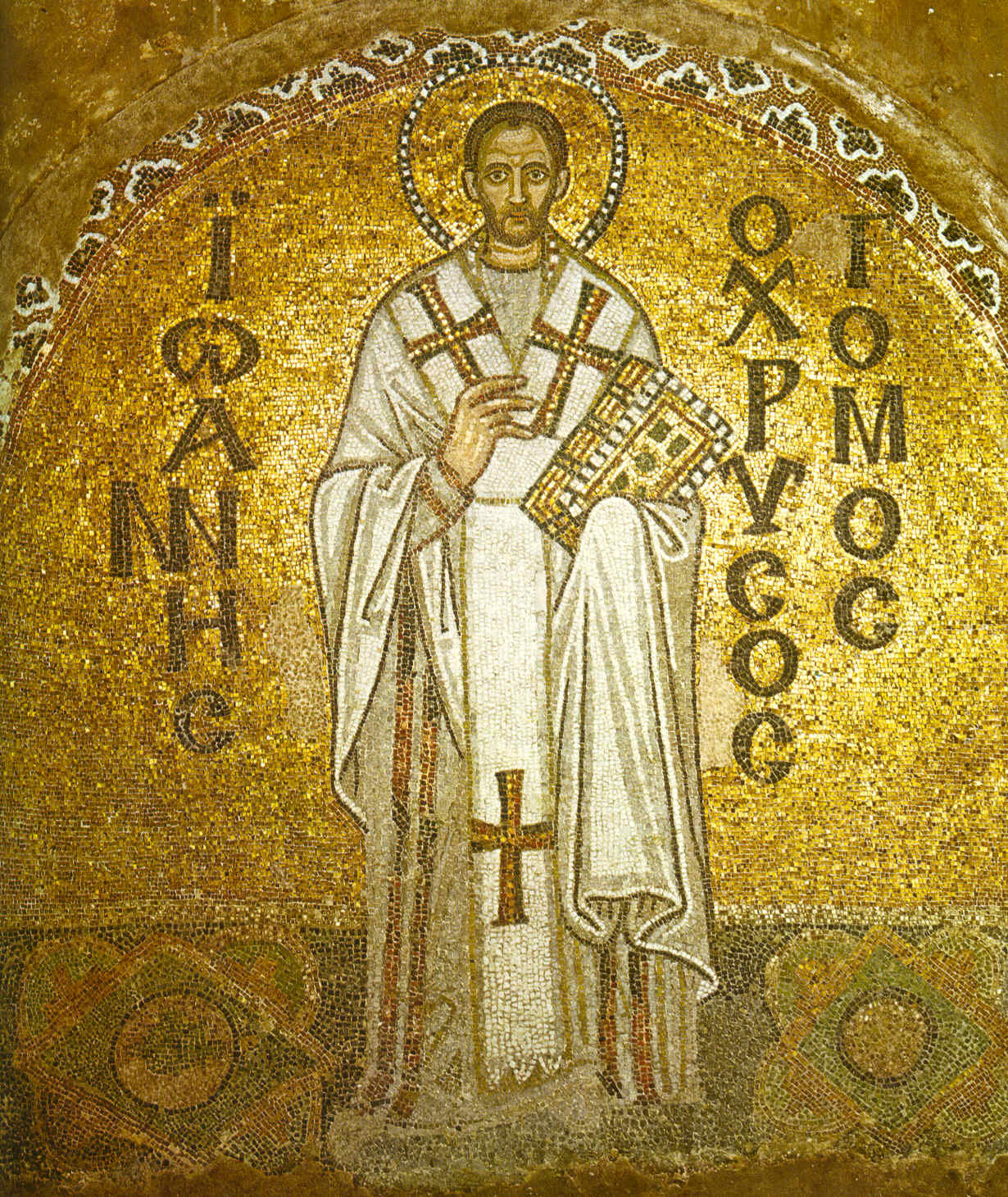
Chrysostom means “golden-mouthed” – and it was a surname given to him posthumously. John (347-407 AD) is known by history as a prolific writer and a gifted preacher. He presented straightforward expositions of Holy Scripture, spoke against a abuses of authority, and kept people engaged for long public sermons. One brief history of John’s life included this bit of flavor: “Audiences were warned not to carry large sums of money when they went to hear him speak, since pickpockets found it very easy to rob his hearers -- they were too intent on his words to notice what was happening.” (James Kiefer)
In one of his homilies, John preached, “The bee is more honored than other animals, not because it labors, but because it labors for others.” What lovely words that ring true to our Christian call to serve those in need! His words remind me of Saint Stephen’s commitment to the care of God’s creation – and the thousands of bees we have on site here. Bees are actually one of the symbols associated with John Chrysostom, but John was not a bi-vocational priest and beekeeper; he’s associated with bees because of the “sweetness of his preaching.” Historian Hans von Campenhausen wrote that his sermons “are probably the only ones from the whole of Greek antiquity which … are still readable today as Christian sermons. They reflect something of the authentic life of the New Testament, just because they are so ethical, so simple, and so clear-headed.”
John Chrysostom reflects on the reading from Galatians 2:11-21 in a brief 4,568 words. If I were to preach verbatim, it would take nearly 45 minutes. For this reflection today, I hold up one piece for us to chew on. John was bishop of Antioch – and he writes about this excerpt in which the Apostle Paul details a conversation with the Apostle Peter (Cephas), in Antioch. Paul’s preaching about this exchange is not to embarrass or demean Peter, rather John Chrysostom says it serves as a teaching to refine and reform the beginnings of Christian life, living into the Law and by faith in Jesus the Son of God. (You may read the entirety of his commentary of the Letter to the Galatians here.)
As I close, I offer you this prayer of John Chrysostom that we sometimes read during Morning Prayer. May these words open you to the hope and consolation of God this day:
A Prayer of St. Chrysostom
Almighty God, you have given us grace at this time with one accord to make our common supplication to you; and you have promised through your well-beloved Son that when two or three are gathered together in his Name you will be in the midst of them: Fulfill now, O Lord, our desires and petitions as may be best for us; granting us in this world knowledge of your truth, and in the age to come life everlasting. Amen.
-- Katherine+
Questions for Reflection
Who is someone you can listen to, and as they speak, time stops and you are swept away?
What messages of hope and consolation, what sweet words, do you need to hear today? With whom might you share these same words?
Daily Challenge
Take ten minutes to learn more about the Great Doctors of the Ancient Church by clicking this link: https://www.ccel.org/fathers.html

Do Not Pray for Easy Lives - January 26
Reflection for January 26, 2021
Today’s Readings: AM Psalm 45; PM Psalm 47, 48; Isa. 48:12-21; Gal. 1:18-2:10; Mark 6:1-13
Today’s Reflection
In the scene we enter through today’s passage from Mark 6, Jesus summons his friends together so that he can then send them out on their own, two by two. Apostles are ones who are sent out, and here is the moment when Jesus empowers the Twelve to cast out unclean spirits, cure sickness, gather the lost sheep, and proclaim the good news. As Jesus does this, he gives them some advice:
He called the twelve and began to send them out two by two, and gave them authority over the unclean spirits. He ordered them to take nothing for their journey except a staff; no bread, no bag, no money in their belts; but to wear sandals and not to put on two tunics. He said to them, ‘Wherever you enter a house, stay there until you leave the place. If any place will not welcome you and they refuse to hear you, as you leave, shake off the dust that is on your feet as a testimony against them.’ So they went out and proclaimed that all should repent. They cast out many demons, and anointed with oil many who were sick and cured them. –Mark 6:7-13
In this moment, Jesus is commissioning the disciples (those who are his followers) to now become apostles (those who are sent out). He is sending them out, entrusting them to go out on a mission of their own, and he is giving them this wise advice to carry with them in their hearts and in their minds as they set out on their journeys.
And the crux of what Jesus is telling them is this: Travel light. You don’t need to carry a lot of stuff with you. Just bring yourself—all that you are, all that I have created you to be. And I will provide for you along the way. You will meet people along the way who will come alongside you, to shelter you and provide for you—people who believe their ministry is, in part, to support you living into the vision God has cast for you and through you. And you also will meet some people who will not welcome you or support you in your sense of call—don’t let them hold you back from your journey.
Know this, Jesus says: I have given you everything that you need. You are ready for this quest. Be brave, hold onto faith, and go out and do the work I have given you to do. Kind of sounds like Jesus is giving them (and us) a pep talk, which is appropriate, since the apostles are beginning a new thing—and maybe we are, too.
As I read Mark’s account of Jesus’ commissioning the disciples to go out and do the work he has given them to do, I am reminded of words of wisdom offered at the Evening Prayer service the night before our seminary commencement in Austin. Inspired by thoughts originally penned by Bishop Phillips Brooks of Massachusetts, Bishop Andy Doyle of Texas passed this wisdom along to us as we were on the precipice of being sent out from seminary into the work each of us was called to do:
Do not pray for easy lives but pray instead to be stronger people for the living of life.
Do not pray for tasks that are equal to your gifts, and talents, and treasure,
but instead pray for the gifts, and talents, and treasure to meet the tasks that are in front of you.
For in that way, when anything is finished, any mission undertaken, any ministry accomplished,
it will not be the miracle—but instead you will be the miracle.
And every day you shall wonder at the mercy, love, grace, and power
that has come from God through you into the world.
I pray that, just as the disciples had the faith needed to become apostles, that we, too, will have the faith to step out in faith—to live fully into the mission we have been set: to share God’s love, mercy, grace, and power with all the world.
—Becky+
Questions for Self-Reflection
Where do you see yourself and your story in the Gospel passage we read for today? Are you like the prophet rejected in your own hometown? Are you like the disciples looking with trepidation at the mission Jesus was setting before them? Or are you like someone else in this story? How so?
Daily Challenge
Pray today in thankfulness to God “for setting us at tasks which demand our best efforts” and for God “leading us to accomplishments which satisfy and delight us.” But also acknowledge what God has taught you through “those disappointments and failures that lead us to acknowledge our dependence on [God] alone.” (For the full text of A General Thanksgiving, see p. 836 of the Book of Common Prayer.)

Turning to a Different Gospel - January 25
Daily Reflection for January 25, 2021.
Today’s Readings: AM Psalm 41, 52; PM Psalm 44; Isa. 48:1-11; Gal. 1:1-17; Mark 5:21-43
I’m still a little bitter about falling out with a person I was friends with in middle school. His name was Jay, and he lived around the corner and two streets over. At our small Episcopal school, our birthdays were close together and neither of us was overly athletic. This meant we were relegated to the latter half of being picked in war ball or the other PE games and so we naturally found ourselves in similar circles.
I can remember him ringing the doorbell one afternoon. He was wearing his Atlanta Braves ball cap and had the newspaper in his hand. “John, John! The Grateful Dead are coming to Memphis and I’m going to get 4 tickets and can take my best friends! One of those tickets has your name on it. We are going to see the Dead!”
Well, it was several weeks before the Dead concert and I guess Jay’s parents were in an overly generous frame of mind, and the number of tickets was growing each week. The next week, Jay had eight tickets. At the same time, there was a growing push for Jay’s tickets. His stock in PE was rising as mine was falling and all of a sudden the jocks were now Deadheads and my relationship with Jay was fading. By the time the concert finally rolled around, there were ten tickets on the table and I was not on the list. A bunch of people that I didn’t realize were friends with Jay had paid homage to one of the greatest bands of all times on their last or second to last tour.
It’s amazing how quickly our attention changes. I am guessing this is pretty human. I mean, Adam and Eve are in paradise (the Garden of Eden) and they turn their attention to the one thing they are told is not for them. How quickly we can become focused on the next best thing. Paul must have forgotten this, because he acts surprised when he says, “I am astonished that you are so quickly deserting the one who called you in the grace of Christ and are turning to a different gospel.” Really, Paul? They are human. Why are you surprised? They think they have found the next best thing!
We too have received the grace of God. It should be the greatest message of love and hope that we have ever received. I am betting there have been moments when you have felt that you have felt the grace of God in such a profound way that it has left you utterly changed. And yet, part of being human is be tempted to replace that Gospel with something else. Maybe our love of our political ideology, or status, or prestige, or our career, our ego, or football team begins to become our most important identity. Don’t worry, it’s a human thing to do. But Paul offers us a reminder not to replace the Gospel of Christ with something else. In Paul’s words, we have become conditioned to seek ‘human approval’ but Paul reminds us it is God in Christ that has set us apart, not those other things that we too easily fall in love with. May we trust in Paul’s word, and in God’s grace and love for each of us.
John+
Questions for Self-Reflection: Have you ever felt replaced by someone? How did that make you feel? Have you done the same to others?
Daily Challenge: When you think of your identity, what are things that you love or believe that make you who you are? Spend some time considering how God’s love for you is more important and how that might change your identity.

Eye contact - January 23
Reflection for January 23, 2021.
Today’s Readings: AM Psalm 30, 32; Isa. 46:1-13; Eph. 6:10-24; Mark 5:1-20
Even with masks over the lower part of our faces for this relatively short part of our lifetime, there is something very powerful about seeing one another’s eyes. Our eyes can communicate much of what is going on with us internally or externally. As I think about eyes and the influence they command, a kid named Lulu comes to mind.
About 10 years ago, Sam and I volunteered as coaches for youth baseball in Southside. The Dizzy Dean team we coached was called the “Red Hots,” and we played at Avondale Park, just as it had been restored and renovated. The kids were 9 and 10 years old, and for many, this was their first time hitting pitches thrown by their peers (rather than their coaches). It was a team of spunky girls and boys, with varied levels of expertise and backgrounds. Imagine the Bad News Bears; the Red Hots were cut from the same cloth. One kid on the team was Lulu. She was scrappy and full of enthusiasm, with long, brown, wavy hair and a starry-eyed approach to life. Lulu always doodling, even in the dirt.
As we got to know Lulu and her family more, we were also warned of when she would give the stink-eye. Some call it the skunk eye, and there are varied tales of the source of the term – perhaps even to Hawaiian surfer roots – but in short, in case it’s a foreign term to you, getting the stink-eye from Lulu meant that, while the facial shift was restricted mainly to the region of her eyes, the feelings brewing beneath that precious imp were a mixture of disgust, distrust, and general disagreement with the status quo. (Perhaps you have even given someone a look like this.) A show-boating, gloating uber-athlete (at the tender age of 10) could elicit such a glare, if he impugned Lulu’s ability as she stepped up to the plate. Her dad’s interference with something counter to her plan could also earn a scathing stink-eye. And as with many families with multiple children, Lulu’s younger sibling was a frequent flyer in the gaze of the stink-eye. Sam coached Lulu and the Red Hots through that season, regardless of stink-eye status, and we had a gloriously fun experience.
I keep thinking about what we express and how we connect with others through our eyes. The Psalmist in Psalm 32 writes of the challenge of being “coached” by God through the rhythms of repentance. These words that have been said, sung, and chanted draws us into this prayer of reflecting about how we know what a state of peace we reach when we are “right” with God – forgiven for the wrongs we’ve done. And yet, it’s hard to name our sins before God. When we hold in those burdens, it feels as though our bones wither, and we cannot hold it any longer: “Then I acknowledged my sin to you, and did not conceal my guilt.” (v. 5) After confession, the Psalmist – and we – are forgiven and protected by God. Then, the Lord surrounds us with shouts of deliverance, offering words of instruction – much like a coach from the sidelines. God bellows, “I will instruct you and teach you in the way that you should go; I will guide you with my eye.” (v. 9a) What words of beauty and encouragement, that gladden my heart.
Friends, the way we get to enjoy the gifts of mercy, forgiveness, and healing bestowed upon us by the sacrifice of Jesus is to keep eye contact with God. We get to practice keeping eye contact with God, letting God’s eye guide us – and hopefully it won’t be the stink-eye too often. We get to try to listen as God, wielding a whistle and clipboard, outlines the rules and coaches us in the ways that we should go. We get to stay immersed in the Good News by reading the Bible. We stay connected by praying for one another and talking with God. We keep serving God by being with those in need. And, when we make an error, we repent and return to the Lord rejoicing, for our sins have been put away.
-- Katherine+
Questions for Reflection
Who has been a coach for you, in daily life or in a more spiritual realm?
What do you imagine about God’s eye? What images or feelings come up for you?
Daily Challenge
Be attentive to making eye contact with people today and the week ahead. Listen for any emotions that you feel. Are you more deeply connected? Are you feeling uneasy? Think about the action of being connected with others so that you may understand them better -- and take that approach with prayer to God, too -- seeking eye contact!

Peace! Be Still! - January 22
Reflection for January 22, 2021
Today’s Readings: AM Psalm 31; PM Psalm 35; Isa. 45:18-25; Eph. 6:1-9; Mark 4:35-41
Today’s Reflection
In today’s passage from the prophet Isaiah, we receive a striking description of who God is: God created the heavens and formed the earth, and when God did this, Isaiah tells us, “he established it; he did not create chaos, he formed it to be inhabited.” When God made the world, he made a world that would be livable, a world in which we would be able to find God and have access to him and his truth: “I did not speak in secret, in a land of darkness; I did not say to the offspring of Jacob, ‘Seek me in chaos.’ I the LORD speak the truth, I declare what is right” (Isaiah 45: 18-19). In a world in which there are so many conditions that seem out of our control—be they natural disasters, medical emergencies, political conflicts, personal traumas—it is comforting to know that we are not left to navigate these conditions alone in the dark. We have been given a light to show us the way through the chaos and the darkness—we have direct, personal access to God, who gives us light by speaking the truth and declaring what is right.
The Gospel of Mark includes a glimpse of how Jesus embodied this reassuring, peaceful presence amid life’s storms by showing us Jesus out in a boat during an actual storm: “A great gale arose, and the waves beat into the boat, so that the boat was already being swamped. But he was in the stern, asleep on the cushion; and they woke him up and said to him, ‘Teacher, do you not care that we are perishing?’ He woke up and rebuked the wind, and said to the sea, ‘Peace! Be still!’ Then the wind ceased, and there was a dead calm. He said to them, ‘Why are you afraid? Have you still no faith?’” (Mark 4: 37-40). Here, we see in Jesus a peace that emanates from within—Jesus’ response was not driven by external conditions (the great gale, the beating waves) but rather by his internal spiritual condition of a peacefulness made possible by faith. Jesus as the Son of God knew that, ultimately, God is in control, even when all the external signs—everything we can see and hear in our immediate surroundings—seem to indicate a state of chaos beyond anyone’s control.
Speaking from my own experience, I have to say that I do experience moments in life when it feels like I have been left to fend for myself amidst some strong winds and waves, strong enough to knock me down and overwhelm me. And yet, in the end, they don’t. I am still here, and you are still here—the winds and the waves haven’t overwhelmed us after all. It is comforting to know that our God is one who does not leave us alone to navigate in dark, stormy, and chaotic conditions but instead is a God who we can approach, a God who knows when we are feeling overwhelmed, and who can help us to pray along with Jesus: “Peace! Be still!”
As you go about your life in the days to come and find yourself searching for a way to connect with the reassuring, peaceful presence of Christ as you navigate the chaos of life in this world, I leave you with this Celtic prayer to help center you and surround you with the presence of God:
God to enfold me,
God to surround me,
God in my speaking,
God in my thinking.
God in my sleeping,
God in my waking,
God in my watching,
God in my hoping.
God in my life,
God in my lips,
God in my soul,
God in my heart.
God in my suffering,
God in my slumber,
God in my ever-living soul,
God in mine eternity.
From a collection of prayers from the Hebrides, The Carmina Gadelica, III, 53.
—Becky+
Questions for Self-Reflection
What conditions in life make you feel as if you are set adrift in a small boat in a very stormy sea? In those moments, how have you been able to reconnect with a sense of God’s peace amidst the storm?
Daily Challenge
Listen to or read the lyrics of the song “13 (There is a Light)” and as you do, ask God to bring to mind someone who is going through a difficult time and pray about how God could use you to share some peace with them this day, whether through saying a prayer, sending a note, or making a call.

Bearers of God's Light - January 21
Daily Reflection for January 21, 2021.
Today’s Readings: AM Psalm 37:1-18; PM Psalm 37:19-42; Isa. 45:5-17; Eph. 5:15-33; Mark 4:21-34
Sometimes I feel sorry for my dog and cat. Bailey will full on tackle them, snuggling up with the animals on the floor or a bed in a four-point bear hug, trying to literally cover them in love. I am surprised that they even seem to more than tolerate it most of the time. It’s cute as can be and reminds me that most people (and creatures) just want to love and be loved.
A neighbor recently organized bringing dinners on Wednesday nights to another neighbor who had surgery inviting the whole neighborhood to care for her as she was on the mend. More than a few people in our congregation have reached out to ask how they might use stimulus money to care for people in need in the larger community. Last night, half of the people who picked up church dinners dropped off large bags of non-perishable items to be delivered through Community Kitchen’s mobile food pantry. There is a whole lot of goodness going on and I know I’m not even scratching the surface. One might call it light shining in this world.
Yesterday, I was struck by the twenty-two-year-old inaugural poet, Amanda Gorman’s, powerful vision for our future where she concluded, “for there is always light, if only we’re brave enough to see it, if only we’re brave enough to be it.” Gorman’s words stand on their own and yet they provide an interesting way of us exploring today’s Gospel passage from Mark.
In today’s passage, Jesus also reminds us that there is always light. In this story, he is speaking to the twelve disciples and uses some strong language. “Let anyone with ears to hear listen!” Many translations add the exclamation point. Prior to that line, Jesus asks the question, “Is a lamp brought in to be put under the bushel basket, or under the bed, and not on the lampstand? For there is nothing hidden, except to be disclosed; nor is anything secret, except to come to light.” The image of God’s light being all-consuming and present is brought to mind. Can you imagine everything being exposed to the light of God?
As I think of Gorman’s words as a person of faith, for me, it is not initially a question of bravery, but of faith. Jesus reminds us that it is not a question of whether or not there is light, but how we and God shine that light on everything else. For some that is letting others know about hope, love, and God’s promise. For others, it is through acts of compassion, service, and humility. See there is a lot of goodness going on all around. It’s happening when a child bearhugs a pet. It’s happening through random acts of charity and generosity. It’s happening when people put the needs of others above themselves. It’s happening all around, and we have the choice to tell the world about it. May we be brave enough to be bearers of this light and Good News when our world seems on edge, waiting for the worst. May we be God’s light shining bright.
John+
Questions for Self-Reflection: Where do you see wonderful things happening? Do you find it easier to share the negative things of the world or the positive? Why is that so?
Daily Challenge: Today, post a picture or story on social media of someone you know doing a wonderful act of kindness. Maybe include a call to action for others to emulate.

All that is good and right and true - January 20
Reflection for January 20, 2021.
Today’s Readings: AM Psalm 38; PM Psalm 119:25-48; Isa. 44:24-45:7; Eph. 5:1-14; Mark 4:1-20
One Christmas, my parents gave me a clear acrylic phone with a neon tube inside, that would emit this glowing flash of blue light when the phone rang. It was so cool. That gift signaled a threshold moment – a phone jack to be installed in my own bedroom. It was a big deal, and I was so excited. Here’s what else happened as that source of light came alive in my room: I could have phone conversations in the privacy of my own room, rather than tangled up in the long phone cord in the kitchen, where other listening ears (my sisters) were ready to soak up any information I leaked about a person or scenario. Calls in our house needed to be made prior to 8:00 p.m. and should be wrapped up by 9:00 p.m. Any time after that, a ringing phone signaled an emergency, and it was unacceptable to call people so late.
So, while there were areas of my teenage life that were vexing and created grist for my emotional mill, it was magnificent to sit on my four-poster bed and talk on the phone to my best friend Ali. We would discuss homework, social dilemmas of high school, objects of our affection, stressors from our home life…and we listened to one another. Ali has been one of the most important confidantes and guides of my life. She has been a sounding board and source of honesty and encouragement. As time took us different directions geographically for education, work, and building our lives, we exchanged long letters and emails. Ali continues to be an amazing writer, can interpret literature with the best of them, and has this gift of opening my eyes to new truths - or simply to point out ones that were always there, but I had not opened my eyes to them. Ali’s goal, as I see it, has been toward being good soil, and bearing fruit that is worthy and honest.
The goal of good soil is one of the themes in the powerful scriptures appointed for today, pointing us toward opening our ears to receive the word of God and shine that light of promise upon others. In Isaiah, we have the prophesy of Cyrus, in which the Lord promises the restoration of the Temple in Jerusalem through the machinations of the temporal pagan king of Persia. The scripture foretells of Cyrus, who reigned around 560 BCE, stating that he will be equipped by the Lord to be used for God’s glory, so that people know God.
In Mark 4, Jesus is teaching. We hear not just the extended metaphor of seed being sown upon various types of dirt and terrain, but also Jesus’ interpretation of that parable, guiding listening ears to understanding…so that we might move toward the hope of being rich soil to receive the word of God. And why would we do this? For our own benefit and glory? No, to bear fruit of beauty and sustenance to pass along to others. We are called to bear fruit that is worthy and honest.
Paul’s letter to the Ephesians calls his listeners to be imitators of God and to live in Christ’s love. “Live as children of light – for the fruit of the light is found in all that is good and right and true.” (5:8b-9) Paul continues in verse 11, “Take no part in the unfruitful works of darkness, but instead expose them.”
What healthy fruit grows when the soil is rich and light from God filters upon the leaves of the Lord’s flora! Today, as we welcome new challenges in our own lives and in that of our nation with the inauguration of Joe Biden, the 46th President of the United States, let us strive to be good soil, with God’s help. Let us bear fruit that is worthy and honest, with God’s help. And let us live as children of light, remembering that it is in God we trust.
-- Katherine+
Questions for Reflection
Who is a friend who is a confidante and source of truth for you? For whom do you fill this role?
What kind of soil do you feel like today? Rocky? Shallow? Weedy? Healthy?
Daily Challenge
What does it mean to you to bear worthy and honest fruit today? Ponder what that feels like, and how it is manifested. Is it in the words you say? Or the mindset you embody going about your day? Pray and reflect for two minutes in silence about how God, who made all things, can stir and move you.

All-Consuming - January 19
Reflection for January 19, 2021
Today’s Readings: AM Psalm 26, 28; PM Psalm 36, 39; Isa. 44:9-20; Eph. 4:17-32; Mark 3:19b-35
Today’s Reflection
“You were taught to put away your former way of life, your old self, corrupt and deluded by its lusts, and to be renewed in the spirit of your minds, and to clothe yourselves with the new self, created according to the likeness of God in true righteousness and holiness.” –Ephesians 4:23-24
What does it mean “to put away your former way of life” and instead “be renewed in the spirit of your minds”? According to Paul, it means this: Put away falsehood. Speak the truth to our neighbors. Do not let the sun go down on your anger. Labor and work honestly. Share with the needy. Let no evil talk come out of your mouth. Build others up, so that your words may give grace. Put away all bitterness and anger. Be kind and tenderhearted. Forgive as you have been forgiven (Ephesians 4: 25-32). Through giving us these principles, God (via Paul) laid out a rule of life by which we will be set apart from the rest of the world.
Likewise, we read in Isaiah today about the utter insufficiency of idol creation and idol worship: “All who make idols are nothing, and the things they delight in do not profit; their witnesses neither see nor know. And so they will be put to shame. Who would fashion a god or cast an image that can do no good? Look, all its devotees shall be put to shame; the artisans too are merely human” (Isaiah 44: 9-11).
Not worshipping idols (human-made objects of worship) absolutely runs counter to American consumer culture and the advertising industry that promotes it. Pretty much any object, person, or pursuit has the potential to be put in a place of reverence. It could be anything that we spend too much time thinking about, obsessing about even, to the point that it takes our time, attention, and energy away from other things—especially away from worshipping God and living in accord with God’s pattern of self-emptying love.
While organized religion and places of worship are waning in influence in many Western cultures, the cult of consumer culture continues to gain in influence and adherents. James Twitchell, in his book Lead Us into Temptation: The Triumph of American Materialism, says, “Tell me what you buy, and I will tell what you are and who you want to be.” He explores how “the purchase and possession of things” are “the self-identifying acts of modern life. Not only does the car you drive tell others who you are, it lets you know as well. The consumption of goods … provides us with tangible everyday comforts and with crucial inner security in a seemingly faithless age.” Ultimately, Twitchell believes that “we buy more than objects, we buy meaning.”
But it’s not so easy to be satisfied solely by God’s love, mercy, and grace in a world in which we are constantly tempted to be satisfied by absolutely everything else. We are tempted to obey our urges to consume and to compete. Just buy it. Just do it. Treat yourself—because you only live once! Our competitive culture tells us that sacrifice is good—but by that the culture means you should sacrifice your sleep, your health, your time with family, your time for worship—sacrifice yourself and your relationships so that you can get ahead, climb the ladder, achieve that next big thing.
As Christians, though, we lead lives of paradox. We are to be “in the world, but not of it.” We are stuck, on the one hand, in the mud and muck of this fallen world. And yet we are also set free, like a kite or a banner, free to fly and wave in the wind, yet anchored by the security we have in Christ, so that we do not fly off into the atmosphere of our own inclinations.
We may have moments of realization that we are drowning and dying in a sea of mistakes and regrets—and then we are brought back up to the surface, brought back to life, realizing the undying hope we have in Christ. We feel unknown, and yet can take comfort that in Christ we are fully known. We realize that while, at the end of the day, we may have nothing in the eyes of this world, in terms of status or wealth or other measures of success—and yet, in Christ, we already possess everything that is truly needful.
—Becky+
Questions for Self-Reflection
In which idol (a material object or worldly pursuit) are you most often tempted to find your identity and sense of self-worth? What do you think it is about this object or pursuit that tricks you into thinking that it is the key to finding happiness and meaning in your life?
Daily Challenge
Hear more of James Twitchell’s thoughts on how people in the United States are tempted to make brands and amenities into modern-day idols.